Who’s wife is she anyway!
Marriage at the Resurrection
18 Then the Sadducees, who say there is no resurrection, came to him with a question. 19 “Teacher,” they said, “Moses wrote for us that if a man’s brother dies and leaves a wife but no children, the man must marry the widow and raise up offspring for his brother. 20 Now there were seven brothers. The first one married and died without leaving any children. 21 The second one married the widow, but he also died, leaving no child. It was the same with the third. 22 In fact, none of the seven left any children. Last of all, the woman died too. 23 At the resurrection whose wife will she be, since the seven were married to her?”
24 Jesus replied, “Are you not in error because you do not know the Scriptures or the power of God? 25 When the dead rise, they will neither marry nor be given in marriage; they will be like the angels in heaven. 26 Now about the dead rising—have you not read in the Book of Moses, in the account of the burning bush, how God said to him, ‘I am the God of Abraham, the God of Isaac, and the God of Jacob’? 27 He is not the God of the dead, but of the living. You are badly mistaken!”
Mark 12: 18-27

Moreton, Dorset: 6th June 2025
We can’t help noticing as we read chapters 11 and 12 of Mark’s gospel that most of the major groups of first century Israel, religious and political, have come together into an uncomfortable coalition to take down this Jesus. First, it was the temple leaders, sent in like the advanced guard to catch him out. Jesus publicly humiliates them. Then it was the unlikely joint battalions of the Herodians and the Pharisees. Their attempt to catch Jesus out was no more successful, and they retired from the field bruised and silenced.
Next, onto the battle field come the Sadducees. We tend to think of them as a minor sect. In reality, they were important and influential in first century Judaism with a strong presence in the Sanhedrin. For them, Scripture was the Pentateuch – the first five books of what we call the Old Testament. They rejected oral tradition, and did not regard the rest of Hebrew Scripture as the Word of God. They famously rejected, amongst many other things, the idea of resurrection. It’s not surprising, perhaps, that their question is based specifically on the Law (Deuteronomy 25:5-6) with a focus on the subject of resurrection. Sent into battle, their question is intended to catch Jesus out. If he denies the teachings of Moses, he will be guilty of blasphemy. For them, blasphemy is punishable by death.
Here’s the background. According to the Law, where brothers are living together, they have a particular family responsibility to fulfil. If such a married man dies, his brother shall takes the widow as his wife. Any children born from that second union will be counted as children of the dead brother, ensuring the continuity of his family line. This may sound strange in our ears, but it was a means of providing for the widow and her children, and of maintaining the family name. It created a strong family bond.
Like the Herodians, the Sadducees approach Jesus with flattery, addressing Jesus as ‘Teacher’. They then set out some circumstances which they would like him to consider. Rabbi’s are expected to answer ‘tricky’ questions. about Scripture. It’s what they do.
In this case, the circumstances are intended to catch him out. A woman married a man who is one of seven brothers. When he dies, she marries the first brother. That brother dies. You get the picture. Eventually, all seven brothers die. Each of them has spent time as husband of this woman, but she has remained childless. And here’s the catch. When the resurrection comes, whose wife will she be?
Their intent is to make a mockery of the concept of resurrection. Such a matter cannot be properly resolved in the next life. The poor woman would, after all, have seven husbands.
Maybe there was a pause. A moment of silence. A moment of anticipation. The Sadducees, perhaps, start to think they have caught Jesus out. The Law of Moses, they want to say, simply isn’t compatible with your idea of resurrection. To allocate the woman to one brother at the resurrection, would undermine the other six. If Jesus, on the other hand, denies the resurrection, he undermines Jewish teaching and his own. Either way, they will be able to turn the crowd against Jesus and arrest him.
His response was not what they expected.
‘Your question demonstrates that you have no idea what you are talking about!’ The Good News translation says simply, ‘You are wrong!’
Jesus response is in two parts. Firstly, he tells them that in the resurrection we will be like the angels. The very concept of marriage will be redundant. Resurrection is real, says Jesus, but life will not be as we experience it in this world. God can do this. His power is supreme.
Secondly, Jesus was saying that they have misunderstood even the part of Scripture which they accept and teach. When Moses approached the burning bush (Exodus 3), God declared himself to be the God of Abraham, Isaac and Jacob. As written, the language says that these people are not dead. They are alive. Of course, they have left this earthly life. They are resurrected. (This is well within the power of God! We remember that two of the disciples saw both Moses and Elijah at the Transfiguration of Christ).
Far from undermining the Law of Moses, in his response Jesus has affirmed it, whilst challenging them for not fully understanding it. The Sadducees are in something of a fix. They know well that the word of God at the burning bush in Exodus 3 is used to affirm the existence of a resurrection, but in coupling this line with the news that the repeatedly widowed woman will not need a husband in the resurrection offers them little scope for supplementary questions.
To be firmly and publicly told that they are wrong is undermining. To be told by this young rabbi that they don’t understand their own Scripture is embarrassing. In the face of the packed Passover crowd, they are humiliated. They withdraw to lick their wounds.
End Piece
There is reassurance in this story. Firstly, in Christ’s affirmation that resurrection is a thing. Secondly, he affirms that the constraints, rules and privileges of this world do not carry over to the next.
Yet there’s a warning here too. Be careful, says Jesus, how you handle Scripture. Picking out the bits which suit the agenda of your own Church, sect or party is dangerous. Picking and choosing the bits you want and disregarding others is manipulative. It is, in effect, making up your own religion. It is wrong.
And before you point a finger at the Sadducees and cry ‘hypocrite’, look to yourself. It’s great to learn Scripture. I love to hear people quoting Scripture – especially when they do it accurately! But it’s easy to take a verse out of context and build a whole philosophy around it which was never intended.
Scripture was, and sadly sometimes still is, mis-used to justify slavery, misogyny, racism and homophobia.
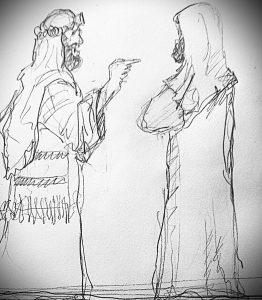
Using Scripture comes with a heavy responsibility. Just be careful. Lest the finger of the Living Jesus points at you and says – ‘You have misunderstood. You are wrong!’
Richard Jackson, West Sussex: LifePictureUK


 We can imagine Jesus and the Disciples, standing near the wall, perhaps in the shade, watching people placing their cash offerings into the ‘trumpets’. If we imagine that we are standing there with them, we will notice the steady movement of people passing through to offer their contribution to the Temple funds. The ‘trumpets’ are made of metal, and so large donations clatter as they are thrown in with a flourish. The noise attracts the attention of people close by. The more noise that is made, the larger the donation. The larger the donation, the greater the attention. The greater the attention, the greater the respect given to the donor. This is a great way to get yourself noticed. The donor stands for a moment in an attitude of contrition and prayer, quietly enjoying the approving glances of those around him.
 Our familiarity with the story of what we call Holy Week can make us underestimate the impact of Jesus disrupting the activities at the Temple, turning over tables, releasing animals and scattering money. He presented a real challenge to the Temple authorities. They knew who he was and that his teaching was attracting a lot of people. His disruptive behaviour and his growing popularity was an affront to their authority. They needed to respond, and they needed to be seen to respond. They were already looking for ways to catch Jesus out, and to get him out of the way. They smelled an opportunity.