Category Archives: Gospel of Mark

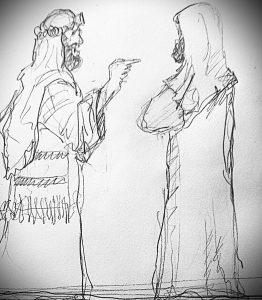
Whose Son is the Messiah? Mark 12:35-37

Whose Son is the Messiah?

 35 While Jesus was teaching at the Temple courts, he asked ‘ Why do the teachers of the law say that the Messiah is the Son of David. 36 David himself, speaking by the Holy Spirit, declared:

‘The LORD said to my Lord
“sit at my right hand
Until I put your enemies
Under your feet”’

 37 David himself calls him ‘Lord’. How then can he be his son?  The large crowd listened to him with delight.

Mark 12:35-37

Horsham: 17th June 2025

The action here takes place on the Wednesday of Holy Week. Jesus is having a busy day at the Temple. The religious and political leaders of Israel are provoking him. They want to arrest him. They want him out of the way. The knives are out. They want him dead.

Yet here is Jesus, out in the open, in the courts of the Temple, attracting attention. He is surrounded by this crowd who have witnessed his public humiliation of Temple Leaders, Herodians, Pharisees and Sadducees. This crowd love him. They are ‘listening to him with delight’ (v37). After all, who doesn’t like to see arrogant leaders slapped down once in a while!

Rabbi’s answer questions. That’s what they do. But sometimes, it is the rabbi who asks the question. In this case, the question he asks may sound strange to us, but it addressed a very familiar concept for the crowd. It’s drawn from Psalm 110. A Psalm of David. There’s a bit of a riddle in here somewhere. The crowd are keen to hear what Jesus thinks.

We need to look closely at the text of Psalm 110 as quoted here. Notice that the word ‘LORD’ appears first in capital letters. That means that in the Hebrew, the original word was ‘I AM’ – ‘Yahweh’. The second time it appears it is not capitalised. That means that the Hebrew word was ‘Adonai’. Adonai is also a name given to God, but is in some sense a lesser title. We might translated it as ‘Sovereign One’. So, we might think that in Psalm 110, God is talking to himself. That’s not the case. David, writing under the inspiration of the Holy Spirit (that’s Christ’s view – see v36), sees Yahweh inviting another, who also shares His Name, to sit at his right hand.

In this riddle, Jesus is saying to the crowd, ‘Who is this that God is calling to sit in the place of honour at his right hand?’ As a Christian, the answer is clear. The ‘Sovereign One’ is Jesus.

‘Psalm 110 is a prophetic Psalm, and David was saying by the Holy Spirit that when the Messiah had finished his labour in this world, He would be exalted to heaven and enthroned at the right hand of God.’ (Sproul, p294)

We can easily misunderstand the importance of King David to the Jews. He is a central and inspirational figure. He is their King. He was a renowned warrior, as well as a musician and poet.

There was a widespread acceptance that the Messiah would come from David’s descendants. There were, of course, many descendants – many ‘son’s of David’ – but only one was going to be Messiah. David was a successful warrior king, and there was a common expectation that the Son of David would be in the same mold. This fed the view that the Messiah would re-establish Israel, leading the nation to victory against Rome. Jesus did not deny that the Messiah would be of ‘David’s Line’ – people had started to call him ‘Son of David’ (eg,    ) but he repeatedly confronted and rejected any sense that he was to be a warrior ‘Messiah’.

So, David is referring to one of his descendants, yet he calls him ‘my Lord.’  It’s true in most cultures that the ‘son’ should respect the ‘father’. In general, that’s how family relationships work. So here’s the riddle. Whilst we know who the LORD is, who is the Lord in Psalm 110, and why does David call him my Lord?

We naturally assume that a ‘son’ would show deference to his father. Yet David creates the image of  himself, the greatest king of Israel, showing deference to one of his descendants – the one who is his son, even calling him his (ie David’s) Lord.

Jesus is born in the line of David (Matthew 1), into the household of Joseph. But Joseph was not his father. His conception was through the Holy Spirit. Whilst we don’t hear Jesus commenting on the title ‘Son of David’, he is saying that he, the one who people regard as the Son of David,  is actually the Son of God. He is immeasurably higher, even than the greatest king of Israel, King David.

In the Psalm, David refers to the Lord – the Son of God. Knowingly or not, David is prophetically pointing towards, and acknowledging the Lordship of Jesus Christ. The Messiah.

End Piece

We view the Old Testament through a very different cultural lens to our Jewish friends. It’s easy for us to underestimate the critical importance of King David in Jewish culture. That’s because we know Jesus as the Messiah. For us, He is the important One.  He is the Son of God.

Jesus had challenged the order of things, even trashing the market in the Temple. The theme of the questions was ‘Who do you think that you are.’ Time and again, because of their own preconceptions and in-grained cultural beliefs, the people in power misunderstood who he was. In reality, they completely misunderstood their opportunity for relationship with him.

When I talk to people about Jesus, the response is often similar. People are still asking the same questions. People have absorbed lots of misinformation about who he is. They trip up on their own cultural beliefs and completely misunderstand who this Jesus is. They completely misunderstand their opportunity for relationship with him.

Yet here we are, 2000 years later, still talking about him. Such is the power of God. That is the influence of the Holy Spirit. That is who Jesus is.

Yesterday, today and forever. Jesus Christ is the same (Hebrews 13:8). Unchanging (Malachi 3:6). Son of God (Mark 14:61-62).
Richard Jackson, West Sussex: LifePictureUK

Greatest Commandment: Mark 12:28-34

The Greatest Commandment

28 One of the teachers of the law came and heard them debating. Noticing that Jesus had given them a good answer, he asked him, “Of all the commandments, which is the most important?”
29 “The most important one,” answered Jesus, “is this: ‘Hear, O Israel: The Lord our God, the Lord is one.[e] 30 Love the Lord your God with all your heart and with all your soul and with all your mind and with all your strength.’[f] 31 The second is this: ‘Love your neighbor as yourself.’[g] There is no commandment greater than these.”
32 “Well said, teacher,” the man replied. “You are right in saying that God is one and there is no other but him. 33 To love him with all your heart, with all your understanding and with all your strength, and to love your neighbor as yourself is more important than all burnt offerings and sacrifices.”
34 When Jesus saw that he had answered wisely, he said to him, “You are not far from the kingdom of God.” And from then on no one dared ask him any more questions.

Mark 12:28-34

Horsham: 16th June 2025

The preceding verses of Chapter 12 have outlined an orchestrated attempt by religious and political leaders to catch Jesus out so that he could be arrested. First the Leaders of the Temple, then the Herodians and Pharisees, and then the Sadducees. These people want Jesus out of the way. They want him dead.

Mark turns our attention to an entirely different situation. This time a normal question comes from someone referred to as a scribe. As their name implies, the key role of the scribes was to make accurate copies of the scriptures (For more info click here: article by Christianity.com).  They were educated, learned and respected men.

‘In Judaism, there was a kind of double tendency. There was the tendency to expand the Law limitlessly into hundreds and thousands of rules and regulations. But there was also the tendency to try to gather up the law into one sentence, one general statement which would be a compendium of its whole message. ‘(Barclay, Loc 5902)

Throughout history, there have been attempts to summarise the core of Scripture. King David did it (Psalm 15). Isaiah did it at least twice (Isaiah 33.15 and 56:1). Micah did it (Micah 6:8). (for a simple discussion of these summaries see Barclay Loc 5902)

It was common for a rabbi to be asked to offer his own summary of the Law, so in the days leading up to Passover, it was reasonable for a scribe to approach a famous rabbi and put this question. “Of all the commandments, which is the most important?”.

The first response is from Deuteronomy 6:4, the opening verse of the Shema, the words which committed Jews use at the start of every day, and which were carried by orthodox Jews in black boxes called phylacteries on their forehead or wrist. Every Jew knows this verse. Neither the scribe nor any other person listening would not be surprised that Jesus offers this verse.

The second part of his response is from Leviticus 19:18. Again, this is a deeply familiar verse.  It was familiar to Jewish people, and it’s familiar to us, although for different reasons. To us, the phrase reminds us of the parable of the Good Samaritan. To the Jewish mind, the ‘neighbour’ means anyone who is part of the family of Israel. Importantly, the way in which Jesus quotes it, he drops that restriction. The teaching of Jesus has a radical edge which we can easily miss.

Unlike those who are seeking Christ’s death, the scribe is not humiliated. He recognises the nuance of what Jesus has said. He affirms Christ’s summary and is himself commended. He is not far from the kingdom of God.

End Piece

‘What does it mean when a person is ‘not far from the kingdom of God’? It means he or she is facing truth honestly and is not interested in the ‘party line’. or even personal prejudices. It means the person is testing his or her faith by what the Word of God says and not by what some religious group demands. People close to the kingdom have the courage to stand up for what is true even if they lose some friends and make some new enemies.’ (Wiersbe, p142)

Richard Jackson, West Sussex: LifePictureUK

Whose wife is she anyway? Mark 12: 18-27

Who’s wife is she anyway!

Marriage at the Resurrection

18 Then the Sadducees, who say there is no resurrection, came to him with a question. 19 “Teacher,” they said, “Moses wrote for us that if a man’s brother dies and leaves a wife but no children, the man must marry the widow and raise up offspring for his brother. 20 Now there were seven brothers. The first one married and died without leaving any children. 21 The second one married the widow, but he also died, leaving no child. It was the same with the third. 22 In fact, none of the seven left any children. Last of all, the woman died too. 23 At the resurrection[a] whose wife will she be, since the seven were married to her?”

24 Jesus replied, “Are you not in error because you do not know the Scriptures or the power of God? 25 When the dead rise, they will neither marry nor be given in marriage; they will be like the angels in heaven. 26 Now about the dead rising—have you not read in the Book of Moses, in the account of the burning bush, how God said to him, ‘I am the God of Abraham, the God of Isaac, and the God of Jacob’[b]? 27 He is not the God of the dead, but of the living. You are badly mistaken!”

Mark 12: 18-27

Moreton, Dorset: 6th June 2025

We can’t help noticing as we read chapters 11 and 12 of Mark’s gospel that most of the major groups of first century Israel, religious and political, have come together into an uncomfortable coalition to take down this Jesus. First, it was the temple leaders, sent in like the advanced guard to catch him out. Jesus publicly humiliates them. Then it was the unlikely joint battalions of the Herodians and the Pharisees. Their attempt to catch Jesus out was no more successful, and they retired from the field bruised and silenced.

Next, onto the battle field come the Sadducees. We tend to think of them as a minor sect. In reality, they were important and influential in first century Judaism with a strong presence in the Sanhedrin. For them, Scripture was the Pentateuch – the first five books of what we call the Old Testament. They rejected oral tradition, and did  not regard the rest of Hebrew Scripture as the Word of God.  They  famously rejected, amongst many other things, the idea of resurrection. It’s  not surprising, perhaps, that their question is based specifically on the Law (Deuteronomy 25:5-6) with a focus on  the subject of resurrection. Sent into battle, their question is intended to catch Jesus out. If he denies the teachings of Moses, he will be guilty of blasphemy. For them, blasphemy is punishable by death.

Here’s the background. According to the Law, where brothers are living together, they have a particular family responsibility to fulfil. If such a married man dies, his brother shall takes the widow as his wife. Any children born from that second union will be counted as children of the dead brother, ensuring the continuity of his family line. This may sound strange in our ears, but it was a means of providing for the widow and her children, and of maintaining the family name. It created a strong family bond.

Like the Herodians, the Sadducees approach Jesus  with flattery, addressing Jesus as ‘Teacher’. They then set out some circumstances which they would like him to consider. Rabbi’s are expected to answer ‘tricky’ questions. about Scripture. It’s what they do.

In this case, the circumstances are intended to catch him out. A woman married a man who is one of seven brothers. When he dies, she marries the first brother. That brother dies. You get the picture. Eventually, all seven brothers die. Each of them has spent time as husband of this woman, but she has remained childless. And here’s the catch. When the resurrection comes, whose wife will she be?

Their intent is to make a mockery of the concept of resurrection. Such a matter cannot be properly resolved in the next life. The poor woman would, after all, have seven husbands.

Maybe there was a pause. A moment of silence. A moment of anticipation. The Sadducees, perhaps, start to think they have caught Jesus out. The Law of Moses, they want to say, simply isn’t compatible with your idea of resurrection. To allocate the woman to one brother at the resurrection, would undermine the other six. If Jesus, on the other hand, denies the resurrection, he undermines Jewish teaching and his own. Either way, they will be able to turn the crowd against Jesus and arrest him.

His response was not what they expected.

‘Your question demonstrates that you have no idea what you are talking about!’ The Good News translation says simply, ‘You are wrong!’

Jesus response is in two parts. Firstly, he tells them that in the resurrection we will be like the angels. The very concept of marriage will be redundant.   Resurrection is real, says Jesus, but life will not be as we experience it in this world. God can do this. His power is supreme.

Secondly, Jesus was saying that they have misunderstood even the part of Scripture which they accept and teach. When Moses approached the burning bush (Exodus 3), God declared himself to be the God of Abraham, Isaac and Jacob. As written, the language says that these people are not dead. They are alive. Of course, they have left this earthly life.   They are resurrected. (This is well within the power of God! We remember that two of the disciples saw both Moses and Elijah at the Transfiguration of Christ).

Far from undermining the Law of Moses, in his response Jesus has affirmed it, whilst challenging them for not fully understanding it. The Sadducees are in something of a fix. They know well that the word of God at the burning bush in Exodus 3 is used to affirm the existence of a resurrection, but in coupling this line with the news that the repeatedly widowed woman will not need a husband in the resurrection offers them little scope for supplementary questions.

To be firmly and publicly told that they are wrong is undermining. To be told by this young rabbi that they don’t understand their own Scripture is embarrassing. In the face of the packed Passover crowd, they are humiliated. They withdraw to lick their wounds.

 End Piece

There is reassurance in this story.  Firstly, in Christ’s affirmation that resurrection is a thing. Secondly, he affirms that the constraints, rules and privileges of this world do not carry over to the next.

Yet there’s a warning here too. Be careful, says Jesus, how you handle Scripture. Picking out the bits which suit the agenda of your own Church, sect or party is dangerous. Picking and choosing the bits you want and disregarding others is manipulative. It is, in effect, making up your own religion. It is wrong.

And before you point a finger at the Sadducees and cry ‘hypocrite’, look to yourself. It’s great to learn Scripture. I love to hear people quoting Scripture – especially when they do it accurately! But it’s easy to take a verse out of context and build a whole philosophy around it which was never intended.

Scripture was, and sadly sometimes still is, mis-used to justify slavery, misogyny, racism and homophobia.

Using Scripture comes with a heavy responsibility. Just be careful. Lest the finger of the Living Jesus points at you and says – ‘You have misunderstood. You are wrong!’

Richard Jackson, West Sussex: LifePictureUK

Give to Caesar what belongs to Caesar: Mark 12:12-17

Give to Caesar what is Caesar’s: This story also appears in Matthew 22 and Luke 20

1Later they sent some of the Pharisees and Herodians to Jesus to catch him in his words. 14 They came to him and said, “Teacher, we know that you are a man of integrity. You aren’t swayed by others, because you pay no attention to who they are; but you teach the way of God in accordance with the truth. Is it right to pay the imperial tax to Caesar or not? 15 Should we pay or shouldn’t we?”

But Jesus knew their hypocrisy. “Why are you trying to trap me?” he asked. “Bring me a denarius and let me look at it.” 16 They brought the coin, and he asked them, “Whose image is this? And whose inscription?”

“Caesar’s,” they replied. 17 Then Jesus said to them, “Give back to Caesar what is Caesar’s and to God what is God’s.”

And they were amazed at him.

Mark 12:12-17

 Moreton, Dorset: 5th June 2025

There is a war on. The temple authorities, the leaders and custodians of the Jewish nation, are determined to be rid of Jesus. He has seriously upset them.

It is Passover. Jerusalem is at bursting point with hundreds of thousands of pilgrims swelling the crowd at the Temple. Their Temple. This Jesus is attracting attention. With so many eyes and ears around, they need to get this right. They need to catch him out in his own words. They want him out of the way. They want him arrested. They want him dead.

They have tried questioning his authority. In reply he told them a parable in which they, the leaders of Israel, were portrayed as the villains. Publicly humiliated, they are forced to retreat.

I can’t escape the idea that there was some kind of secret meeting place, some kind of strategic command point, hidden within the temple, where the leaders of every faction, religious and political, have come together to organise the disposal of Jesus. It is to this headquarters that they withdraw and make their humiliating report. It is quickly agreed that it is time for a new tactic.

Now, like a new tactical deployment in a war game, The Herodians approach Jesus. They are a political group who support the tetrarch King Herod. Herod sees himself as ‘King of the Jews’ and his supporters would be deeply angered by people openly applying that name to Jesus. The Herodians are not a religious faction, but they are sent into battle alongside some Pharisees. These two groups are unlikely partners. But these are challenging times. The need is urgent. Even past enemies sometimes unite in common purpose on the field of battle.

Rather than trying to catch Jesus out by leading him into blasphemy, they try to catch him out in treason against Caesar. They begin with false flattery. ‘We know that you are sincere and show deference to no-one, for you do not regard people with partiality but teach the way of God in accordance with the truth.’ (v14)

This thinly veiled attempt to soften him up, is followed up by what is intended as a killer blow. ‘Is it lawful to pay taxes to Caesar or not? Should we pay them or not?’ If Jesus encourages payment to Rome he is in effect colluding with the Roman occupiers of Israel. This would give the Pharisees the opportunity to stir up the crowd against him as a collaborator. On the other hand, if he criticises the payment of taxes to Rome, the Herodians have him. He will be guilty of treason against Caesar. It’s a two pronged attack. Their confidence is high.

Jesus knows exactly who these people are. If he doesn’t recognise them personally (he probably does), their style of dress indicates the factions which they represent. He recognises the trap. He recognises the hypocrisy.

‘Why are you putting me to the test? Bring me a denarius..’ Roman coins carry the head of the ruling Caesar. Not, I suspect, the response they had anticipated. A coin is quickly found.

‘Whose head is this and whose inscription?’ The answer is obvious. It’s Caesar Augustus. They hold their breath, ready to pounce.  ‘Give to Caesar that which belongs to Caesar…’ The Herodians can’t argue with that. The Pharisees can! The excitement of the Pharisees crumbles when they hear the words ‘Give to God the things which are God’s.’ The Pharisees  can’t argue with that.

There is a moment while it sinks in. Neither the Herodians nor the Pharisees can stir up the crowd. They set out to humiliate him in front of the crowd. Once more, he has turned the tables on them.

Another skirmish lost. Embarrassed, the joint forces of the Pharisees and Herodians beat a retreat to that hidden command post where the strategy is under constant review.

With each lost battle, with each public humiliation, the determination to destroy Jesus increases.

End Piece

There was an expectation within contemporary Judaism that the Messiah would rid Israel of the Roman invaders, re-establishing the Kingdom of God. Jesus had the opportunity to take a very public stand against the Romans. He didn’t take it.

‘Give to Caesar that which belongs to Caesar.’ You are called to live in this world. Even Jesus seems to accept that payment of taxes are one of the few certainties of life. The word translated as ‘give’ or ‘render’ means to ‘pay back’ or ‘give what is due’.

I’m interested that, when these verses are quoted, the second part often gets overlooked. We forget it’s there. That, in case you haven’t noticed, is the really important bit. If Jesus hadn’t said it, the Pharisees would have been all over him! The message is simple. Every good thing that you have comes from God (James 1 17). Jesus isn’t just referring to money. Time. Resources. Gifts. This phrase becomes ‘Give to God what he is due’. Your time. Praise. Worship.

There is no area of your life ‘off limits’ here. In every area of your life, you need to give God that which is due to him. Relationships. School. College. Workplace. Neighbours. Friends. Family. Relationship. Marriage. Finances. Leisure. Nothing in your life is off limits when it comes to your relationship with Jesus. Not even your personal ministry.

You are called to live in this world (John 15:19). But you are not of this world (John 17:14). You are called  serve Jesus. You are called to live differently. That’s counter cultural. That’s what it means to follow Jesus.

‘Give to God that which belongs to God.’ (Mark 12:17)

Richard Jackson, West Sussex: LifePictureUK

Parable of the Tenants: Mark 12:1-12

This parable is referred to as the Parable of the Tenants, and also appears in almost identical form in Matthew 21 and Luke 20.

12 Jesus then began to speak to them in parables: “A man planted a vineyard. He put a wall around it, dug a pit for the winepress and built a watchtower. Then he rented the vineyard to some farmers and moved to another place. At harvest time he sent a servant to the tenants to collect from them some of the fruit of the vineyard. But they seized him, beat him and sent him away empty-handed. Then he sent another servant to them; they struck this man on the head and treated him shamefully. He sent still another, and that one they killed. He sent many others; some of them they beat, others they killed.

“He had one left to send, a son, whom he loved. He sent him last of all, saying, ‘They will respect my son.’

“But the tenants said to one another, ‘This is the heir. Come, let’s kill him, and the inheritance will be ours.’ So they took him and killed him, and threw him out of the vineyard.

“What then will the owner of the vineyard do? He will come and kill those tenants and give the vineyard to others. 10 Haven’t you read this passage of Scripture:

“‘The stone the builders rejected
    has become the cornerstone;
11 the Lord has done this,
    and it is marvelous in our eyes’?”

12 Then the chief priests, the teachers of the law and the elders looked for a way to arrest him because they knew he had spoken the parable against them. But they were afraid of the crowd; so they left him and went away.

Mark 12:1-12

3rd June 2025: Moreton, Dorset

Jesus has been confronted by some of the leaders of the temple community. They have already challenged his authority. Their attack was unsuccessful. They had to back down. They were publicly humiliated. Now, before they can get away, Jesus seizes the initiative by relating this parable.

Parables are generally short stories with a simple but direct message. It’s usually unhelpful to analyse the detail of a parable too closely, but this one is different. Every detail has a meaning. Everyone hearing Jesus was familiar with the idea that in Scripture, the vineyard is a reference to the nation of Israel. Everyone knew about small vineyards with fences, watch towers and tenant farmers. They were all over Israel. Everyone knew that the tenants were required to provide a portion of their produce to the landowner.

Most people hearing the story would have been horrified. The lawlessness described is unthinkable.  Sometimes, tenant farmers did rebel against their landlord, and occasionally things got ugly. But to kill the servants was despicable. To kill the son of the landowner, was unconscionable.

Remember, this is happening during the build up to Passover. So when Jesus mentions Psalm 118 – one of the Hallel Psalms which are spoken by  Passover – something clicks in their mind. They realise that as in Isaiah, the landowner represents God. The penny drops. They recognise who each of the characters in the story represent. They recognise themselves in the story.

In this parable: ‘The tenants are the leaders of Israel into whose hands the nation was entrusted. The messengers are the prophets who were disregarded, persecuted and killed. The son is Jesus himself. And the sentence is that the place which Israel should have occupied is to be given to others.’ (Barclay, The Gospel According to Luke, p.329)

This parable is being told against them. Jesus is saying that before God, they, the leaders of Israel, are the bad guys. Worse still, without actually saying it, Jesus is implying that he is the son. If the landowner is God, Jesus is again claiming to be the Son of God. He is the all important stone which was rejected by them, the builders of Israel. They understand exactly what Jesus is saying. Previous generations of leaders persecuted and executed the prophets. They are planning to kill the son. God’s son.

Be in no doubt. Jesus knew that he, the Son, was to be killed, by them, the keeper of the vineyard. He wants them to know that he knows.

Once more, they are desperate to arrest him. But they are afraid of the Passover crowd.

Once more they are publicly humiliated in front of the temple crowds.

Once more, they have no choice but to walk away.

End Piece

This incident takes place on the Wednesday of Holy Week. This parable tells us that Jesus knows what is ahead. He knows that his death is imminent.

The temple authorities are utterly infuriated. Over and again, their authority has been challenged and their humiliation has been very public. Like wounded soldiers, they retire from the scene of the battle to lick their wounds and consider their next move. These are dangerous men.

Here is Christ. Courageous. Obedient in the face of his earthly enemies. Resolute in the face of approaching and increasingly inevitable death.

For this particular group of leaders this battle may have been lost, but their war against Jesus of Nazareth is not over.

Richard Jackson, West Sussex: LifePictureUK

Jesus Authority Questioned: Mark 11:27-33

Jesus Authority Questioned

27 They arrived again in Jerusalem, and while Jesus was walking in the temple courts, the chief priests, the teachers of the law and the elders came to him. 28 “By what authority are you doing these things?” they asked. “And who gave you authority to do this?” 29 Jesus replied, “I will ask you one question. Answer me, and I will tell you by what authority I am doing these things. 30 John’s baptism—was it from heaven, or of human origin? Tell me!”

31 They discussed it among themselves and said, “If we say, ‘From heaven,’ he will ask, ‘Then why didn’t you believe him?’ 32 But if we say, ‘Of human origin’ …” (They feared the people, for everyone held that John really was a prophet.) 33 So they answered Jesus, “We don’t know.”

Jesus said, “Neither will I tell you by what authority I am doing these things.”

Mark 11:27-33

Horsham. 27th May 2025

‘The chief priests and teachers of the Law [..] were looking for a way to kill Him, for they feared Him, but the crowd were amazed at His teaching’ Mark 11:18

Many people travelled great distances to see what was going on when John was baptising people in the River Jordan. He offered a baptism of repentance for the forgiveness of sins (Mark 1:4). What those people saw stirred them greatly. Many of them accepted John’s baptism for themselves.

In the eyes of many people, this John looked like a prophet. He dressed like a prophet. He spoke like a prophet. He acted like a prophet. Not surprisingly, vast numbers of people believed that John was a prophet sent by God. Many of them knew that this John had not only baptised Jesus, but had pointed to him as the Messiah. ‘Behold,’ he had said, ‘the Lamb of God who takes away the sins of the world.’ John had further raised the perception that he was a prophet because he had been martyred by Herod. John, however, was not recognised by the Jewish authorities. ‘Officially, they had not recognised John. So the official religious leaders kept a cool distance from the Baptist.. The crowds went to hear this preacher but the official leaders kept neutral.’ (Pawson, p.220)

Our familiarity with the story of what we call Holy Week can make us underestimate the impact of Jesus disrupting the activities at the Temple, turning over tables, releasing animals and scattering money. He presented a real challenge to the Temple authorities. They knew who he was and that his teaching was attracting a lot of people. His disruptive behaviour and his growing popularity was an affront to their authority. They needed to respond, and they needed to be seen to respond. They were already looking for ways to catch Jesus out, and to get him out of the way. They smelled an opportunity.

Their reasoning was quite straightforward. Obviously, even Jesus couldn’t be acting on his own authority. If he was, he should be arrested for causing damage. If he claimed to be acting on God’s authority, he would be arrested for blasphemy – a charge for which he could be quickly sentenced to death. Be in no doubt, they meant to kill Jesus. This was their opportunity, and they were going to take it.

The temple is packed. Jesus is teaching in the colonnades of the temple. Such is their confidence that they approach him in the midst of a crowd. They want as many people as possible to hear His blasphemous claims. The problem is, Christ’s response.

Do you remember asking a teacher a question and they answer by asking you a question? It can be really annoying. I know, because as a teacher, I do it all the time. This technique was normal practice for a Rabbi, and it was culturally appropriate to answer the rabbi and then rephrase your own question.

Jesus unexpected question causes a real dilemma. If they admit that John’s ministry was of divine origin, the crowd would be asking why they were not recognising the messianic anointing and authority of Jesus. If they say that John’s baptism was not of God, the crowd would be furious and they would themselves cause a greater disturbance than Jesus had caused the day before. They are caught in a dilemma of their own making.

The volatile crowd who they had hoped would witness the blasphemy of Jesus are now the crowd who are watching them, the temple authorities, floundering. They cannot safely answer his question. They have to publicly back down. They look weak and ineffective. Their pride is knocked. They are sinking further into the mess of their own making.

‘Those who will not face the truth have nothing but the prospect of deeper and deeper involvement in a situation which renders them helpless and ineffective. (Barclay, Loc 5648)’

They were intent of ridding themselves of this turbulent rabbi before, they are determined to do so now.

This is not over.

End piece

We know that as his ministry progressed, Christ’s teaching was increasingly oppositional to the existing power structures of Israel. Those in authority didn’t particularly care whether he was right or wrong. They saw him as a threat to their power, and they wanted rid of him. They were ready to use any tricks they could to do so. They were ready to ignore the constraints imposed upon them by the Law.

An animal is dangerous if it is injured. Powerful men are rarely more dangerous than when the injury is to their pride.

In time honoured tradition, they dismissed his teaching as fake news. They tried ignoring Him. They tried threatening Him. They tried to stir up opposition against Him. They tried cancelling Him. Now, they want to silence him. They are determined. They will succeed.

Fake news. Cancel culture. Abuse of authority. All sounds rather familiar.

‘What has been will be again, what has been done will be done again; there is nothing new under the sun.’ (Ecclesiastes 1:9)


Have Faith in God: Mark 11:22-25

22 ‘Have faith in God,’ Jesus answered. 23 ‘Truly I tell you, if anyone says to this mountain, “Go, throw yourself into the sea,” and does not doubt in their heart but believes that what they say will happen, it will be done for them. 24 Therefore I tell you, whatever you ask for in prayer, believe that you have received it, and it will be yours. 25 And when you stand praying, if you hold anything against anyone, forgive them, so that your Father in heaven may forgive you your sins.’ 

Mark 11: 22-25

Horsham: 19th May 2025

How did we get here?:
These verses follow the discovery by the disciples that the fig tree which had, hours earlier, been cursed by Jesus is now dead (vv 20-21). Our familiarity with the story is such that we can thoughtlessly say ‘the fig tree died’, without pausing to notice the extraordinary supernatural power which lies behind that phrase. Finding that the tree had died so quickly must have left those who had witnessed the event profoundly impacted. In their astonishment, the disciples look to Jesus for an explanation.

Have Faith in God:
Jesus answer is simple, direct and foundational to the teaching which follows. ‘Have faith in God‘ (v22).  Those who walk in the light of the Kingdom, who pray in simple faith, believing in their hearts that nothing is impossible for God, will see powerful and extraordinary answers to their petitions.

William Barclay points out that the claim that faith can move mountains (v23) is common in rabbinic teaching, and appears in Matthew 17:20 and in similar form in Luke 17:6. In each of these instances, the context is different. This saying was never intended to be taken literally. It means that prayer, prayed in faith – faith in the Almighty, all powerful God, can resolve even the greatest of challenges.

Barclay suggests, we might assume that these verses contain phrases which were common sayings of Jesus (Barclay Loc:5562). 

Effective Prayer
First, pray in a spirit of faith, believing that God will answer your prayer (v24). Of course, this assumes that we are doing all that we can to live in God’s will, and that this passion is reflected in our prayers.

Secondly, but just as important, comes the need for forgiveness (v25).

‘And when you stand praying, if you hold anything against anyone, forgive them, so that your father in heaven may forgive your sins.’ (v25)

There is an echo here of Christ’s familiar teaching on prayer. This, he once said, is how we should pray:

‘Forgive us our sins, as we forgive those who sin against us.’ (Matthew 6:12)

But there is something more. Here’s a hugely important lesson.  Forgiveness of others, says Jesus, is an essential pre-requisite for effective prayer.

Context:
So, great teaching, but why has Mark included these teachings at this point in his narrative? What is his context? Mark has just taken us through the incident with the fig tree and the clearing of the temple, both highly symbolic and dramatic parables. The response of the disciples to the sudden death of a fig tree leads Christ to point out that they have failed to grasp the potential supernatural power of prayer.  Rather than being randomly placed alongside these two familiar stories, these teachings are relevant to the theme of his unfolding narrative.

End Piece:
The Apostle Paul tells us to ‘pray constantly’ (1 Thessalonians 5:16-18). If we want to make a difference in this broken world, we must learn how to pray effectively. Pray believing in the supernatural power of prayer. Pray in faith. Pray in confidence. Pray with a thankful and forgiving heart. The forgiving heart, says Jesus, is critical.

‘Perhaps only those who have learnt what that means will be in a position to act with Jesus’ authority against the injustice and wickedness of our own day.’ NT Wright, p151

Richard Jackson, West Sussex: LifePictureUK

Fig Tree and Temple 3: Clearing the Temple Mark 11:15-18

15 On reaching Jerusalem, Jesus entered the temple courts and began driving out those who were buying and selling there. He overturned the tables of the money changers and the benches of those selling doves, 16 and would not allow anyone to carry merchandise through the temple courts. 17 And as he taught them, he said, “Is it not written: ‘My house will be called a house of prayer for all nations? But you have made it ‘a den of robbers.’ 18 The chief priests and the teachers of the law heard this and began looking for a way to kill him, for they feared him, because the whole crowd was amazed at his teaching.

Mark 11: 15-18

17th March 2025: Horsham

(Published on the Crossblog on 30th April 2025)

Jesus has walked the three or four miles from Bethany to the city of Jerusalem. As he left the village, Jesus had effectively put a curse on an apparently healthy fig tree which had provided no fruit. By the time he and his disciples return later that day, the tree will be dead.

His destination is Jerusalem. The Temple. When he arrives, he is  frustrated by the commercial activities taking place in the Temple Courts. I want us to think about what was going on and why.

The Pilgrims: The time of the Passover festival is approaching. The population of Jerusalem is hugely swollen by the arrival of hundreds of thousands of pilgrims. Some have come from the towns and villages around Jerusalem, but many have travelled long distances from around Israel and beyond. For all of them, their destination is the Temple.

Their pilgrimage is spiritual. It’s about spiritual celebration and service. They are there to worship God. That means sacrifice, offering and prayer. For sacrifice they need animals and they must be in peak condition. They need money to pay the temple tax and make offerings. These things can only be sorted at the Temple. In the outer court – the Court of the Gentiles – money can be changed and animals purchased. When Jesus arrives, this Court is full of noise and bustle, focused around the market – the money changers and the animal traders.

There is little space for quiet. Little space for prayer. The traders and the Temple authorities are making money from the market activities. ‘The Court of the Gentiles should have been a place of praying, but it was instead a place for preying and paying.’ (Wiersbe, p.136)

The Traders: Every animal presented for sacrifice has to be in perfect condition. If it is not up to standard, it will be rejected by the priests. Quite clearly, a sheep which has been driven through the wilderness and along dusty roads will not be in the best condition when it arrives at the Temple. Everyone knows that to pass the scrutiny of the priests, it was necessary to buy your animal in Jerusalem. For this purpose, the court of the gentiles, a large public area surrounding the temple itself, had developed into a livestock market, offering certified lambs, oxen and doves. Certfied as suitable for sacrifice. Of course, in the Temple market, the ‘captive audience’ creates the opportunity to inflate the cost of animals. In some cases, those who are poor can offer a dove in sacrifice in lieu of a lamb. There are records of the Chief Priests controlling the prices to minimise the risk of selling doves at extortionate prices to the poorest worshippers, but it does happen. For Jesus and his family this was nothing new. When Christ was born, Mary and Joseph offered two doves (Luke 2:22-24).

The Money Changers: Most of the worshippers are from Israel, so why the need for money changers? The answer is quite simple. The temple has its own currency. Pilgrims need to pay tax at the temple and the only money which was accepted was the Tyrian Shekel. These coins, originally minted in the city of Tyre, are now produced in Judea under license from the Romans. They can only be used within the Temple compound. One feature of the Tyrean shekel is that it had an unusually high silver content and so the value was consistent and clear to everyone. Exchange rates were set by the traders themselves and so there was profit to be made at the expense of pilgrims.

The Temple Authorities: The market is controlled by the Temple authorities, and one reason for high prices is that animal sellers and money changers are required to pay a fee to these authorities to get a license to sell. There is some  evidence that the Temple authorities deliberately inflated prices, but there is also evidence that at times they were instrumental in reducing the burden on pilgrims by driving prices down (for an example see the actions of Rabbi Ben Gamaliel to reduce the price of doves, recorded in the Mishnah, Kerithoth 1:7).

Jesus actions: You’ll know the story. Jesus has very strong views about what is going on. He starts turning over tables of money changers and dove sellers. ‘Is it not written that my temple shall be a house of prayer for all nations!’ (Isaiah 56:7) ‘But you have made it a den of robbers.’ (Jeremiah 7:11). Jesus is really saying, this is the Temple and God expects his people to be producing fruit. In reality, rather than encouraging worship and upholding the Law, the authorities were continuing a situation where space was given to lucrative commerce rather than prayer. Instead of facilitating heartfelt worship, the focus is on making money from it.

The Result: There were several reasons why Christ’s action would have upset the authorities. There was a momentary interruption to cash flow. There is a need to keep control – to be seen to respond to this outrageous behaviour of a Rabbi. A riot in the temple courts will attract the attention, even the intervention of the Romans.  Perhaps worst of all, the people were excited, and attracted to Jesus. Many of them were there when he entered the city, riding a donkey. Many of them had heard that this was the Messiah, and they want it to be true. In this moment, he is clearly, and very publicly, attacking the authorities.  They are, after all, the overseers of the whole thing. So many reasons for the Jewish leaders to want to be rid of him.

End Piece: This was not the first time Jesus had visited the temple. The practices of the market place in the Temple had developed over many generations. It’s easy for us to be critical of the situation that provoked Jesus to take action, but to everyone involved, including the pilgrims, that was just the way things had always worked. The vast majority of people didn’t even notice that they were doing anything wrong, and maybe that’s what really annoyed Jesus.

The real message here is that Israel is not fulfilling it’s purpose before God. The healthy looking fig tree is failing to produce even those small immature fruit which might have been available at this time of year. The fig tree is symbolic of Israel. Like the fig tree, Israel itself is at risk of finding itself deeply out of favour with God.

From time to time we wonder how Jesus would react if he walked into our Church. Maybe, rather than condemning the money changers, animal traders and temple authorities, it might be more fruitful to reflect on what is going on in our own Churches and our own way of life.  If Jesus walked into your world right now, what might attract his attention? (Matthew 7:3-5)

Richard Jackson, West Sussex: LifePictureUK

Fig Tree and Temple 2: The Fig Tree – Mark 11:12-14 and 19-21

12 The next day as they were leaving Bethany, Jesus was hungry. 13 Seeing in the distance a fig tree in leaf, he went to find out if it had any fruit. When he reached it, he found nothing but leaves, because it was not the season for figs. 14 Then he said to the tree, “May no one ever eat fruit from you again.” And his disciples heard him say it.          […]          19 When evening came, Jesus and his disciples[e] went out of the city. 20 In the morning, as they went along, they saw the fig tree withered from the roots. 21 Peter remembered and said to Jesus, “Rabbi, look! The fig tree you cursed has withered!”

Mark 11:12-14 and 19-21

5th March 2025: Horsham

(Published here on 30th April 2025)

Yesterday, I pointed out a literary device which appears in Mark’s gospel which we call the ‘Markan Sandwich’. This device brings two separate stories together with a common theme (the Markan Sandwich is explained here).  In this case, the two stories are the cursing of the fig tree, and the story of Jesus clearing the temple. In this post I’m concentrating on the story of the fig tree.

At first glance, this is a rather strange story. Christ’s actions feel jarringly out of character. We see Jesus ‘using his power to blast a tree which had disappointed him when he was hungry.‘ (Barclay, Loc 5466). This seems particularly harsh on the tree because Mark tells us that figs were not in season. More than ever, we really need some context!

Setting the Scene: It’s early morning. Jesus has spent the night in Bethany, a few miles from Jerusalem, and is making his way to the city where he will visit the Temple. He’s hungry. Whilst figs are not in season, the fact that the tree is in leaf means that it would normally offer some immature edible fruits. These fruits are actually buds called ‘breba or taqsh’ which appear with the first leaves of the spring but don’t develop into fruits. There were no taqsh. The tree looks as if it will serve Christ’s needs. It does not.

The Curse: The ‘curse’ which Jesus places upon the tree is this. “May no one ever eat fruit from you again.” (v14). The incident is reported in Matthew 21. Whilst there are some textual variations in the Greek, in essence the same words are reproduced. This might sound like an expression of anger, but in truth, it is a clear statement of condemnation. Matthew says that the impact was immediate. Mark tells us that the disciples noticed the dead tree at the end of same day. The fact is that the tree rapidly – supernaturally – withers and dies. Yet why, we still want to ask, did Jesus say this to a fig tree?

The Fig Tree: The fact that this is a fig tree is significant. When the twelve explorers were sent by Moses from the wilderness into the Promised Land, they found wonderful things. One of the key things they reported finding was fig trees (Numbers 13:23. Deuteronomy 8:7-9  Fig trees, along with vines, are slow growing. They become identified with peace, stability and safety. In Scripture, the fig tree comes to symbolise Israel itself.

“When I found Israel,
    it was like finding grapes in the desert;
when I saw your ancestors,
    it was like seeing the early fruit on the fig tree.

Hosea 9:10

The End Piece: Here, then, we have an image of Jesus coming to a fig tree, symbolic of the nation of Israel. The fig tree is in leaf. It looks healthy. It looks productive. It looks as if it is fulfilling it’s purpose. Yet at the moment when the Messiah comes, it is found wanting.

There is a warning for us all here. The symbolism is simple. At the moment when the Messiah comes, Israel itself is found wanting.

You also must be ready, because the Son of Man will come at an hour when you do not expect him.” (Luke 12:40)

Richard Jackson, West Sussex: LifePictureUK


Fig Tree and Temple 1: The Markan Sandwich – Mark 11: 12-25

Horsham: 4th March 2025

(Published on The Crossblog 30th April)

You may come across a reference in a commentary or sermon to an aspect of Mark’s style which we call the ‘Markan Sandwich’. This is a literary device in which the writer starts to tell a story. After a short paragraph of introduction, he moves to a second story, before returning to conclude the first narrative. At first glance, the two stories may seem entirely unrelated to each other, but invariably they work together to make or emphasise a point. ‘The middle story nearly always provides the key to the theological purpose of the sandwich.’ (Dr Tim White).

The Sandwich: The ‘Markan sandwich’ device appears 7 times in Mark’s gospel (see the list at the end of this post). In these verses, Mark 11: 12-25,  we have a great example. Mark introduces the story of the fig tree which offers no fruit. He then relates the story of Christ clearing the temple, before returning to the conclusion of the story of the fig tree. We’re going to look at each of these stories, but first, let’s look at the link between them.

The Fig Tree: The fig tree should be able to deliver small fruits which would feed Jesus. These are not mature figs, but a kind of bud, referred to as a ‘breba’ in Spain, or a ‘taqsh’ in arabic countries. These small buds, which do not develop into full figs, appear in the cooler months of spring and are edible. They’re not a great delicacy, but if you were hungry, you would eat them.

This tree looks as if it should be capable of producing fruit. On close inspection, it offers nothing.

The Temple: In the Jewish mind, temple was a place of worship and sacrifice. Jesus reacted strongly to the corrupt commercial market which was being held within its’ walls. The market was the only, or at least the most visible, activity in the temple courts.

The temple looked as if it was capable of producing fruit for God, but on close inspection, Jesus found that it was failing in its purpose. The main activity was buying, selling and money changing, with some traders taking advantage of the many pilgrims and visitors.

The Link: Let’s start by noting that the Jews regarded the fig tree as symbolic of Israel. This is rooted in Old Testament imagery.

The fig tree’s fruitfulness is a metaphor for the nation’s blessing and favor from God. Conversely, the absence or destruction of fig trees symbolizes judgment and desolation. (see BibleHub commentary: ‘Symbolism of the Fig Tree)

We’ve already noticed that both the fig tree (which somehow represents Israel) and the temple (which should be the beating heart of Israel) are failing to produce fruit which is at the core of their created purpose.  Consequently, both are condemned by Christ. The destruction of the fig tree is immediate. In context, we see a performative parable which prophecies the destruction of the temple. That destruction is just as real and takes place at the hands of the Romans, nearly 40 years later.

The Lesson: In context, these two stories sit perfectly together and contribute to a single purpose. The lesson is simple. The follower of Jesus must produce fruit for the kingdom. That is our purpose. In these performative parables, Jesus criticises those who look as if they are being effective, but in reality they are not. Each of us, and every Church of every generation, needs to sit up and take note.

‘I know your deeds. You have a reputation for being alive, but you are dead!’ (Revelation 3:1)

Richard Jackson, West Sussex: LifePictureUK

For a simple but detailed review of the ‘Markan Sandwich’, see article by Dr Tim White, Professor of Ministry and Theology, Carolina University. 

The seven examples of the Markan Sandwich

Mark 5:21-43: The story of Jairus and the woman with the hemorrage;

Mark 6:7-30: The sending out of the Twelve and the death of John the Baptist.

Mark 11:12-21: The condemnation of the fig tree and the clearing of the temple;

Mark 14:1-11: The Plot to kill Jesus, including Judas’ betrayal, and the anointing of Jesus at Bethany

Mark 14:17-31 Christ’s prediction of his betrayal by Judas and Peter, and the Last Supper

Mark 14:53-72 Peter in the courtyard of the High Priest and interrogation of Jesus

Mark 15:40-16:8 The women at the cross and the tomb, and Christ’s body claimed by Joseph of Arimathea