All posts by admin

Fig Tree and Temple 1: The Markan Sandwich – Mark 11: 12-25

Horsham: 4th March 2025

(Published on The Crossblog 30th April)

You may come across a reference in a commentary or sermon to an aspect of Mark’s style which we call the ‘Markan Sandwich’. This is a literary device in which the writer starts to tell a story. After a short paragraph of introduction, he moves to a second story, before returning to conclude the first narrative. At first glance, the two stories may seem entirely unrelated to each other, but invariably they work together to make or emphasise a point. ‘The middle story nearly always provides the key to the theological purpose of the sandwich.’ (Dr Tim White).

The Sandwich: The ‘Markan sandwich’ device appears 7 times in Mark’s gospel (see the list at the end of this post). In these verses, Mark 11: 12-25,  we have a great example. Mark introduces the story of the fig tree which offers no fruit. He then relates the story of Christ clearing the temple, before returning to the conclusion of the story of the fig tree. We’re going to look at each of these stories, but first, let’s look at the link between them.

The Fig Tree: The fig tree should be able to deliver small fruits which would feed Jesus. These are not mature figs, but a kind of bud, referred to as a ‘breba’ in Spain, or a ‘taqsh’ in arabic countries. These small buds, which do not develop into full figs, appear in the cooler months of spring and are edible. They’re not a great delicacy, but if you were hungry, you would eat them.

This tree looks as if it should be capable of producing fruit. On close inspection, it offers nothing.

The Temple: In the Jewish mind, temple was a place of worship and sacrifice. Jesus reacted strongly to the corrupt commercial market which was being held within its’ walls. The market was the only, or at least the most visible, activity in the temple courts.

The temple looked as if it was capable of producing fruit for God, but on close inspection, Jesus found that it was failing in its purpose. The main activity was buying, selling and money changing, with some traders taking advantage of the many pilgrims and visitors.

The Link: Let’s start by noting that the Jews regarded the fig tree as symbolic of Israel. This is rooted in Old Testament imagery.

The fig tree’s fruitfulness is a metaphor for the nation’s blessing and favor from God. Conversely, the absence or destruction of fig trees symbolizes judgment and desolation. (see BibleHub commentary: ‘Symbolism of the Fig Tree)

We’ve already noticed that both the fig tree (which somehow represents Israel) and the temple (which should be the beating heart of Israel) are failing to produce fruit which is at the core of their created purpose.  Consequently, both are condemned by Christ. The destruction of the fig tree is immediate. In context, we see a performative parable which prophecies the destruction of the temple. That destruction is just as real and takes place at the hands of the Romans, nearly 40 years later.

The Lesson: In context, these two stories sit perfectly together and contribute to a single purpose. The lesson is simple. The follower of Jesus must produce fruit for the kingdom. That is our purpose. In these performative parables, Jesus criticises those who look as if they are being effective, but in reality they are not. Each of us, and every Church of every generation, needs to sit up and take note.

‘I know your deeds. You have a reputation for being alive, but you are dead!’ (Revelation 3:1)

Richard Jackson, West Sussex: LifePictureUK

For a simple but detailed review of the ‘Markan Sandwich’, see article by Dr Tim White, Professor of Ministry and Theology, Carolina University. 

The seven examples of the Markan Sandwich

Mark 5:21-43: The story of Jairus and the woman with the hemorrage;

Mark 6:7-30: The sending out of the Twelve and the death of John the Baptist.

Mark 11:12-21: The condemnation of the fig tree and the clearing of the temple;

Mark 14:1-11: The Plot to kill Jesus, including Judas’ betrayal, and the anointing of Jesus at Bethany

Mark 14:17-31 Christ’s prediction of his betrayal by Judas and Peter, and the Last Supper

Mark 14:53-72 Peter in the courtyard of the High Priest and interrogation of Jesus

Mark 15:40-16:8 The women at the cross and the tomb, and Christ’s body claimed by Joseph of Arimathea

#BTW: Good Friday

Milton Keynes: 18th April 2025

I’ve had a great week but I have been on the road a lot. Last night I found myself staying at a hotel in Milton Keynes. I use this place fairly frequently, and it’s normally reasonably quiet. This, however, is Good Friday. The Easter break. Quiet it was not!

Breakfast Time…
This morning, the breakfast room was very busy. There were lots of families, teenagers, grandparents. and  smattering of individuals and couples. Loads of people were browsing their phones, or tablets. One or two business people were keeping their heads down, tapping away at laptops. Not the quiet breakfast I had anticipated.

So, there I was with my second cup of coffee. I was reading the bible on my phone.  I was using Bible Gateway (other apps are available). I read the Good Friday passages in all four gospels. Well done me. Treasure in heaven.

I looked around the room, at all the busy-ness and chatter going on around me, people rushing backwards and forwards with drinks and plates of food. It occurred to me with a sense of heaviness that I might be the only person on this room who would even notice that would open my bible today.

Lesson One …
As I was reflecting on all this, I had this image of myself sitting alone in that breakfast room in a place of absolute stillness. I saw myself in focus, whilst all this other stuff went on around me in an out of focus blur. It was a special picture which sort of created an awareness of Christ’s presence in that room. (Psalm 46:10). God is there. Even in the busiest places.

It was a reassuring image. It felt good. Moments like that give me confidence. They build me up. But they occasionally have a context. Sometimes they have an edge.

Lesson 2 …
A short while later, I went for a walk and reflected prayerfully on this image I had seen. In my mind, I looked around again at the people in the room who were not reading the Bible. In my spirit, God sort of asked me who I thought I was to judge them? He reminded me that whatever I might think, His heart is for every one of these people. From the youngest (there was an adorable three month old baby very close by)  to the oldest (I was far from being the oldest). He reminded me that I am a very average judge of character. He reminded me that I knew nothing about these people or their relationship with Him. I am looking at them from the outside. Only he can see their hearts. (1 Samuel 16:7b) When will I learn? Ouch!

Lesson 3 …
Then, he kind of showed me the image again. This time it was sort of reversed. I was part of the rush and bustle. I was in the blur. Passing  the table where I had been sitting I saw myself as others would have seen me. ‘What do you see? Do you see an angel? Do you see a great and  unmissable witness to God’s saving grace?’ 

No. What I saw was a man in late middle age, sitting in a hotel breakfast room, surrounded by the debris of his breakfast, sipping a luke warm cup of coffee, browsing his phone. He didn’t look particularly happy. A man looking, now I come to think about it, pretty much like everyone else. (Do not think of yourself more highly than you ought: Romans 12:3)

The End Piece …
Well done me? Treasure in heaven? Maybe not!

One cup of coffee. Three lessons. I am a work in progress.

Richard Jackson, West Sussex: LifePictureUK


Triumphal Entry 4: That Prophecy (Zechariah 9:9)

Perspective..
I’m passing through London on a train, looking at the skyline. I can see a series of tall buildings. Skyscrapers. My eyesight is pretty good and I can see them clearly. Now I know London pretty well, but if I didn’t, I would be hard pressed to be certain which block is nearest or which one is furthest away. Understanding perspective can be a challenge.

Chapter, Verse and Context..
In ancient times, Scripture was not divided into chapters and verses. There’s no question that the introduction of this device has made it easier for us to find and reference specific parts of Scripture, but there is a downside. Even before chapters and verses, students were able to find their way through Scripture, but their familiarity was based on context and themes. But even then, things were still open to interpretation. Once again, getting the right perspective is a challenge.

A Familiar Verse..

Rejoice greatly, Daughter Zion!
    Shout, Daughter Jerusalem!
See, your king comes to you,
    righteous and victorious,
lowly and riding on a donkey,
    on a colt, the foal of a donkey.

Zechariah 9:9

We’ve learned this verse. It’s familiar to us, but it was never really intended to stand alone. Understanding the context is critical to understanding what is going on as Jesus enters Jerusalem.

Our Perspective..
This seems straightforward. We make the connection to Jesus, righteous and virtuous, riding a donkey on Palm Sunday. We see him as Messiah, greeted by a welcoming crowd, waving palm leaves and shouting ‘Hosanna’.  For  us, this Jesus is the fulfilment of the prophecies of the child born to be King (2 Sam 7:12-13), and the suffering servant (Isaiah 53}. His resurrection defines him as One who conquers death. So when we read this we see Jesus, coming as King, riding on a donkey, ready to suffer for our salvation.

The Crowd Perspective…
This crowd is really excited. There is joy. ‘Joy’ doesn’t really convey what is going on. This is exuberance. This is sheer jubilation. Why? Because they know all about the prophecies of Zechariah. and they believe that Jesus, this Jesus, is the Messiah. After the long winter of God’s silence, his Son is here! They are shouting ‘Hosanna’  – the word means ‘save now’. This crowd believes that Jesus, riding on his donkey, is capable of delivering salvation.

Sounds pretty similar to our interpretation. But this crowd is looking at a very different Messiah from the one we see.

The Jewish Perspective..
This crowd is almost exclusively Jewish, and their cultural lens is very different from ours.  For them, Zechariah is a great prophet, but the prophecy doesn’t stop at the end of what we call verse 9. In reality, they know the prophecies of Zechariah better than we do. They knew all of it. For them,  there was a wider context. The themes of these prophecies were in their DNA.

To catch a glimpse their perspective, their interpretation, their context, we need to look beyond verse 9.

10 I will take away the chariots from Ephraim
    and the warhorses from Jerusalem, 
and the battle bow will be broken.

In the Jewish mind, the coming Messiah will rid Israel of it’s enemies. He will rid Jerusalem of the chariots and war horses of their oppressors (v10). He will restore peace to Israel ‘from sea to sea, from the rivers to the ends of the earth,‘ (v10) He will free those who are captive (v11), he will restore their security and wealth – he will give them hope (v12). He will give Israel victory over the gentile oppressors (v13). This messiah will bring physical, literal and long lasting restoration to the nation of Israel (v14-15).

This is their expectation of the coming Messiah. This is the ‘restoration’ which the coming Messiah would bring to Israel.   Here is their messiah. Here is their King. This is the Messiah they are so excited about.This is the ‘salvation’ which they believe that Jesus will deliver.

The idea of this messiah facing his death in Jerusalem in a few days time was not on their agenda.

Two Very Different Perspectives..
The first part of the prophecy speaks of a King riding a donkey, symbolic of his coming in peace. That’s the part we focus on. This second half speaks of the King who will come in force and power. One Messiah. That’s the part which the Jews were focused on.

Two prophecies.. One Messiah..
You start to get the picture. There are two very different, but entirely accurate, expectations of the Messiah. The suffering servant and the conquering hero. These two descriptions of the Messiah, both rooted in prophetic writings, look as if they are in conflict with each other. Actually, they’re not. We all need to adjust our lenses so that we can see the bigger picture.

It’s a bit like my story about the London skyline. We’ve effectively got two prophecies about the Messiah. Both are familiar. They both foretell the coming of the Messiah. Each of them relates to a specific point in history. The problem is that it’s not the same point. When we read them, our spiritual eyesight doesn’t tell us which is the nearest and which is furthest away.

 The End Piece..
Jesus, this Jesus, is the Messiah. In that, we agree with most of this excited crowd.

A few days after this exuberant scene, Jesus is arrested, tried and crucified. To us, his death, and the resurrection to come, affirm that He is the Messiah.  His journey leads to seismic, universal and eternal change. Light overcomes darkness. The veil over God’s sanctuary is torn. Good triumphs over evil. Life is victorious over death.

To this Jewish crowd, however, his death is profoundly undermining. Their Messiah should defeat the Romans, not be killed by them. So, what about the conquering prophecy of a Messiah  who will restore peace and deal with Israel’s enemies?

After his death and resurrection there was a 40 day period when people, lots of people, saw Jesus face to face. There were many, many witnesses to his resurrection (1 Corinthians 15). At the end of that 40 day period, he was taken up into heaven. You can read that part of the story in Acts 1. Notice verse 11:

this Jesus, who has been taken up from you into heaven, will come in the same way as you saw him go into heaven.Acts 1:11

Did you notice the words, Jesus […] will come back..’ The theme continues throughout New Testament writings.

The teaching of the Apostles Paul, Peter and John are crystal clear. These are the guys who had been taught directly by Jesus. He will be back, and when he returns, it will herald another time of seismic, universal and eternal change. This time, justice and peace will be restored. Jerusalem will be restored. The enemies of the redefined Israel will be dealt with and crushed, and the Kingdom of God will be restored.

Jesus often said that those around him were so close to understanding, and maybe that was true of this crowd.

I don’t think that there’s any doubt that many people in this noisy crowd did, in that moment, believe that Jesus was the Messiah, but they were anticipating the imminent fulfilment of the wrong part of Zechariah’s prophecy. It’s a question of perspective. The one which they thought was nearest, was actually furthest away.

Christ has died
Christ is risen
Christ will come again.

Richard Jackson, West Sussex: LifePictureUK


Triumphal Entry 3: Symbolism – Mark 11:1-11

11 As they approached Jerusalem and came to Bethphage and Bethany at the Mount of Olives, Jesus sent two of his disciples, saying to them, “Go to the village ahead of you, and just as you enter it, you will find a colt tied there, which no one has ever ridden. Untie it and bring it here. If anyone asks you, ‘Why are you doing this?’ say, ‘The Lord needs it and will send it back here shortly.’”

They went and found a colt outside in the street, tied at a doorway. As they untied it, some people standing there asked, “What are you doing, untying that colt?” They answered as Jesus had told them to, and the people let them go. When they brought the colt to Jesus and threw their cloaks over it, he sat on it. Many people spread their cloaks on the road, while others spread branches they had cut in the fields. Those who went ahead and those who followed shouted,

“Hosanna!”

“Blessed is he who comes in the name of the Lord!”

10 “Blessed is the coming kingdom of our father David!”

“Hosanna in the highest heaven!”

11 Jesus entered Jerusalem and went into the temple courts. He looked around at everything, but since it was already late, he went out to Bethany with the Twelve.

Mark 11:1-11

Horsham: 27th February 2025

The moment has arrived. Having walked hundreds of miles from Caesarea Philippi, down through Galilee, Perea, and into Judea, Jesus and the disciples eventually arrive at Jerusalem.

The arrival of Christ into Jerusalem was spectacular. Riding the colt of a donkey, seated on a makeshift saddle of the coats of his closest friends, at the head of a procession of his disciples and followers, Jesus arrives at the incredibly busy city. The normal population of Jerusalem would have been around 25.000 people. When Jesus arrived on this occasion, there would be many hundreds of thousands of people crammed into the narrow streets within the city walls.

‘No incident so shows the sheer courage of Jesus as this does. In the circumstances, one might have expected him to enter Jerusalem secretly and to keep hidden from the authorities who were out to destroy him. Instead, he entered in such a way that the attention of every eye was upon him.’ (Barclay, Loc 5429)

The symbolism of his Kingship would have been glaringly obvious. Excitement builds quickly in a crowd, and the noise, reverberating off the buildings in the narrow streets must have been intense. We can imagine people joining and following the procession, shouting joyfully.

Riding a Donkey… The familiar prophecy of Zechariah 9:9 is part of a wider web of prophetic writing which led the people of Israel to anticipate the coming of the King of Israel on a donkey.

Deeply rooted in the Jewish consciousness of the Old Testament was the hope of the King who would enter Jerusalem as their coming Messiah while riding on a donkey.’ (Sproul, p251)

Coats Laid on the street… Around 850 years earlier, in the days of Elisha, a man called Jehu , an army officer, was anointed King of Israel (2 Kings 9). When his anointing became known, ‘they all took their coats and spread them before him on the steps […] and proclaimed ‘Jehu is King’. Jehu became a powerful King, who brought to an end the notorious rule of Ahab and Jezebel. Jehu was a great King, but he was not the Messiah.

Palm Branches:  The people cut palm branches to welcome Jesus. Coats were spread on the ground, as they were before King Jehu. Palm branches, symbolising joy and praise were cut and waved before him as they had been when Judas Maccabaeus arrived as King 200 years earlier (2 Maccabees 8-10). Judas Maccabaeus was a victorious king, but he was not the Messiah,

Worshipping Jesus: ‘Hosanna’ – correctly translated as ‘Save Now!’. Along with the phrase ‘Blessed is he who comes in the name of the Lord!’, the crowd are shouting Scriptures at Jesus. They called him ‘Son of David’. God had promised David a Kingdom to be ruled over by his descendants (2 Samuel 7:12-16). Again, this cry affirms Christ as the King of Israel. They are declaring Christ as the King. They are proclaiming him as the Messiah. This is less an act of street theatre – this is an act of worship.

Keep these people quiet!: In Luke’s version of this Scripture, the Pharisees call on Jesus to silence his followers. They see him as undeserving of the acclaim he is receiving. ‘If they stopped shouting,’ says Jesus, ‘even the stones themselves would start to sing!’ (Luke 19:39-40). This is a crowd which will not be silenced. This is a move of God which will impact the whole of Jerusalem, the whole of Israel, the whole of the world.

Get the Picture?: Here comes Jesus, riding on a donkey, followed by a joyful and excited crowd, laying down their coats, waving palm leaves. They’re ready to follow Him, but they haven’t really understood who he is at all.

End Piece: Imagine for a moment that you were tasked with the risk assessment. Jesus, celebrity rabbi and leader of a faction oppositional to the Jewish leadership, decides to visit Jerusalem at the height of the Passover feast when the population of the city is swollen to bursting and policed by an edgy and potentially violent garrison of Roman soldiers. What would you recommend?

You might reasonably argue for a ‘low key’ approach which would minimise the risk of hostility from the Pharisees or the Romans. You might reasonably look for the quietest route into the city, and advise Jesus’ followers to make their own way into town in small groups, dispersed amongst the crowd. This approach was not on Christ’s agenda.

He has walked many hundreds of miles to reach Jerusalem, and told his followers (at least three times) that his arrival would lead to his death.

‘Jesus came to Jerusalem to die, and he desired that all Jerusalem should know it.’ (Ryle p166)

His approach was to take the central role in a powerful and deeply meaningful scene. No-one could miss the symbolic references. That doesn’t necessarily mean that they understood their true meaning.

In this scene we see Jesus as the coming King of Israel. Unlike that crowd, we get to view this scene through the lens of the resurrection.

He is the Son of David. Be in no doubt, this Jesus truly is the Messiah.

Richard Jackson, West Sussex: LifePictureUK


Triumphal Entry 2: About this Donkey!

Horsham: 25th February 2025

So, about this donkey! There is so much symbolism in the passage about the Triumphal Entry, that I’m breaking it into shorter posts. This may feel like something of a digression, but I want to focus for a moment on the donkey!

They went and found a colt outside in the street, tied at a doorway. As they untied it, some people standing there asked, “What are you doing, untying that colt?” They answered as Jesus had told them to, and the people let them go. When they brought the colt to Jesus and threw their cloaks over it, he sat on it. 

Mark 11:4-7

Maybe it’s because I have a little experience of working with them, but as I’ve been trawling through the Gospels and commentaries about the Triumphal Entry into Jerusalem I have been thinking about the donkey (Mark 11:1-11).

Donkeys are wonderful, social, curious creatures. They have a rather undeserved reputation for stubbornness. Whilst they can be strong willed, they are intelligent animals and will be cautious if they are uncomfortable with people or situations. In biblical times, donkeys were widely used to transport people  (eg 1 Kings 1:33) and goods (eg Nehemiah 13:15).

The idea of a King riding on a donkey may sound strange to us, but not so in the ancient world. The image of a King, riding on a donkey, symbolises humility (as opposed to riding on a horse which symbolises strength and power).

Horses and donkeys who were fortunate enough to live in the royal stables were strictly reserved for use by the King. In general, no-one else would ride them. Jesus appears to own very little, and certainly no livestock, so he borrows a donkey. He chooses a colt. No-one has ridden this animal before the King. So, now we see Jesus riding a donkey, coming in peace and humility, on a colt which has only ever been ridden by him. If you were in that crowd, you could hardly miss that Jesus was a King. (Barclay, Loc 5391}

’This was a colt prepared for the King!’ (Sproul p251)

Of course, Jesus isn’t just a king. He’s the King. He’s the one who rides in front of a noisy crowd, visibly fulfilling the prophecy of Zechariah 9:9:

Rejoice greatly, Daughter Zion!
    Shout, Daughter Jerusalem!
See, your king comes to you,
    righteous and victorious,
lowly and riding on a donkey,
    on a colt, the foal of a donkey.

It’s hard to imagine an unbroken colt calmly accepting an unknown rider and walking through crowded, noisy streets, followed by an exuberant and cheering crowd of disciples and supporters of Jesus. Does the comfort of the animal in this challenging situation again point to an unspoken degree of planning on the part of Jesus? Could it be that his preparations included familiarisation and building of trust between Christ and the animal? These things are possible, although not explicit in the text. Could it mean that the owner of the young donkey walked with him, providing reassurance? Again, it’s possible.

Of course, there is an alternative explanation. We could not put on this prophecy fulfilling spectacle without considerable planning, including no doubt training, spreadsheets, form-filling and committees. Jesus, on the other hand, was capable of rather greater spontaneity.

This, we remind ourselves, is Jesus. Son of David. The ‘one who comes’ in the Name of the Lord. The ‘Messiah’. To the one who calmed the storm and healed the leper, to the one who gave sight to the blind and turned water into wine, keeping a young donkey calm and under control in extreme circumstances would not, one might think, present the greatest of challenges.

Richard Jackson, West Sussex: LifePictureUK


Triumphal Entry 1- Preparation: Mark 11:1-3

The Triumphal Entry 1 – Preparation

11 As they approached Jerusalem and came to Bethphage and Bethany at the Mount of Olives, Jesus sent two of his disciples, saying to them, “Go to the village ahead of you, and just as you enter it, you will find a colt tied there, which no one has ever ridden. Untie it and bring it here. If anyone asks you, ‘Why are you doing this?’ say, ‘The Lord needs it and will send it back here shortly.’”

Horsham: 24th February 2025

This is one of those moments – there are others – where it is clear that Jesus has planned ahead. This would not be his first time in Jerusalem or Bethany. He was, after all, close friends with Mary, Martha and Lazarus. He clearly knew where the colt he was after would be found, and had arranged a ‘password’ which would encourage the owner to immediately release this valuable animal into the care of his disciples.

The word ‘colt’ can refer to a young horse or a young donkey. Matthew’s version of this story tells us that the ‘colt’ in question was a donkey (Matthew 21:1-3).  As we’ll see, this is an important distinction. Donkeys were a common sight in Palestine. They were (and across north Africa and the Middle East they still are) useful working animals, frequently used as a means of transport for goods and people. In the parable of the Good Samaritan, for example, the injured man was transported on the back of a donkey (Luke 10:25-37). Such a thing was normal. They were valuable animals, and so also treated with respect.

Kings would have a choice of transport. The contemporary image of a king who is on his way to fight a war, would be riding a horse, or in a chariot pulled by one or more horses. In this context, the horse is a symbol of power and strength. A king, however, who comes in peace would ride a donkey. The donkey symbolises humility. A donkey is a perfectly good mode of transport for a king (1 Kings 1:33). He may come in humility and peace, but he still comes as King.

Jesus chose to ride in to Jerusalem on a donkey. The colt of a donkey.

End Piece: It’s easy to overlook the powerful testimony of the man who owned the donkey colt and the valuable lesson he teaches us. It’s simple to describe, but very challenging to live out. It is this. If you own it, and Jesus needs it, he can have it.

Christ’s entry to Jerusalem is in the form of a carefully planned and constructed public display, in a tradition which we see in Jeremiah and other prophets of the Old Testament. ‘His action was a deliberate dramatic claim to be the Messiah.’ (Wm Barclay, Loc 5298)

These verses show that, whilst the outpouring of support from people which will follow on the streets of Jerusalem may have been spontaneous, Christ’s arrival on a donkey colt was not. It was actually carefully planned and designed to make a specific impact.

How would people recognise the gesture he was planning to make? The first century population of Palestine would put many of us to shame with their knowledge of Old Testament Scripture. To many, and certainly to the Jewish leaders, the reference would have been unmissable.  Here was a dramatic scene which enacts a familiar prophecy:

Rejoice greatly, Daughter Zion!
    Shout, Daughter Jerusalem!
See, your king comes to you,
    righteous and victorious,
lowly and riding on a donkey,
    on a colt, the foal of a donkey.

(Zechariah 9:9)

Richard Jackson, West Sussex: LifePictureUK

Blind Bartimaeus: Mark 10:46-52

Blind Bartimaeus Receives His Sight

46 Then they came to Jericho. As Jesus and his disciples, together with a large crowd, were leaving the city, a blind man, Bartimaeus (which means “son of Timaeus”), was sitting by the roadside begging. 47 When he heard that it was Jesus of Nazareth, he began to shout, “Jesus, Son of David, have mercy on me!” 48 Many rebuked him and told him to be quiet, but he shouted all the more, “Son of David, have mercy on me!”

49 Jesus stopped and said, “Call him.” So they called to the blind man, “Cheer up! On your feet! He’s calling you.” 50 Throwing his cloak aside, he jumped to his feet and came to Jesus. 51 “What do you want me to do for you?” Jesus asked him. The blind man said, “Rabbi, I want to see.”

52 “Go,” said Jesus, “your faith has healed you.” Immediately he received his sight and followed Jesus along the road.

Mark 10:46-52

Horsham: 19th February 2025

We are in Jericho, a small town at the bottom of a steep road about twelve miles below Jerusalem. It’s a green place, an well watered oasis on the edge of hostile wilderness. Bartimaeus, aware of the crowds passing through towards Jerusalem for the Passover, is sitting at the roadside begging.

When he hears that Jesus of Nazareth is passing by, he’s on his feet shouting at the top of his voice. He’s calling Jesus, using a messianic title ‘Son of David.’  People are irritated – perhaps embarrassed. This, after all, is a street beggar. Lowest of the low. Except, perhaps, tax collectors.

The unthinkable happens. Jesus stops in this busy street and tells someone, I’d like to think it’s James or John, to bring the beggar to him. Throwing aside the tools of his trade, Bartimaeus allows himself to be led to Jesus. Then something even more extraordinary happens.

A day or so earlier, Jesus had used the phrase, ‘What would you like me to do for you,’ to James and John. They asked to sit in the best places in heaven, beside Jesus. They wanted to be seen as the first amongst the followers of Jesus. Jesus told them and the other disciples, that this isn’t how the kingdom works. If you want to be first, you must be last. Your place is to serve. Here, on a dusty street in Jericho, is the love of Jesus in action. Jesus, the Messiah, Son of David, speaks to the man who is lowest of the low and asks that same question:  ‘What do you want me to do for you?’ How can I, Jesus, serve you, the beggar?

What a contrast. Bartimaeus asks for, and is given, his sight. ‘Your faith has healed you.’

End Piece: We’ve seen that in this act of reaching out to this beggar, Jesus was enacting his teaching about the kingdom. I’d love to know whether James and John got the message. But I want to end this post by shining a light on the star of the show, Bartimaeus.

When Christ called Bartimaeus, he threw aside his blanket on which he sat to beg, and onto which people would throw coins. This should have reminded James and John of the moment when they abandoned their father’s boat to follow Jesus (Mark 1:16-20). It’s as if Bartimaeus knew, as soon as Jesus called him, that he wouldn’t need the trappings and tools of his old life again. Like James, John and the other disciples, when Jesus called, Bartimaeus followed.

When Jesus called, there was no hesitation – Bartimaeus literally jumped at the opportunity. When Jesus asked what he wanted, Bartimaeus was ready with his answer. He didn’t ask for greatness. He asked for his sight. He wanted to see Jesus. He took what Jesus gave him and, in his gratitude, he became a follower of Jesus.

This is the last recorded healing of Jesus, and it is the first and only occasion where we are given the name of the person healed. We know that Bartimaeus immediately followed Jesus, the one he called upon as the Messiah. I’d like to think that when Mark wrote his gospel, there would have been people around who would know or remember this man Bartimaeus. Mark’s saying, ‘you know who I mean by Bartimaeus – this is his testimony!’

Jesus and the disciples have walked hundreds of miles, from Caesarea Philippi in the north, through Galilee and Perea, into Judah and Jericho. Jesus has told his followers that his earthly journey will end in Jerusalem. The last stretch is up a very steep hill. There are just twelve miles to go.

Richard Jackson, West Sussex: LifePictureUK

Request of James and John: Mark 10:35-45

The Request of James and John

35 Then James and John, the sons of Zebedee, came to him. “Teacher,” they said, “we want you to do for us whatever we ask.” 36 “What do you want me to do for you?” he asked. 37 They replied, “Let one of us sit at your right and the other at your left in your glory.”

38 “You don’t know what you are asking,” Jesus said. “Can you drink the cup I drink or be baptized with the baptism I am baptized with?” 39 “We can,” they answered. Jesus said to them, “You will drink the cup I drink and be baptized with the baptism I am baptized with, 40 but to sit at my right or left is not for me to grant. These places belong to those for whom they have been prepared.”

41 When the ten heard about this, they became indignant with James and John. 42 Jesus called them together and said, “You know that those who are regarded as rulers of the Gentiles lord it over them, and their high officials exercise authority over them. 43 Not so with you. Instead, whoever wants to become great among you must be your servant, 44 and whoever wants to be first must be slave of all. 45 For even the Son of Man did not come to be served, but to serve, and to give his life as a ransom for many.

Mark 10:35-45 (NIV)

Horsham: 17th February 2025

In the last verses, Jesus warned of his impending arrest, abuse and death at the hands of the Jewish leaders and the Gentile Romans. This is the third time that he has given a warning to the disciples, and the third time that they have struggled to understand his meaning. Jesus is, after all, the Messiah. He should be ridding Israel of the Romans – not getting killed by them.

After the first warning of his death (Mark 8:31), Peter challenged Jesus, earning a stern rebuke. After the second warning (Mark 9:31), they were frightened to ask Jesus anything, but then we saw the disciples arguing amongst themselves about who was the greatest. ‘These men seemed blind to the meaning of the cross.’ (Wiersbe, p124).

Here, after the third warning, we again see some kind of power play amongst the disciples. As ever, we need to get some context. In Matthew 19:28, Jesus made a promise that the disciples would sit on twelve thrones in heaven alongside Jesus, in judgement over the twelve tribes of Israel. They are, after all, followers of the King, and kings get to decide who sits where. Their closest advisors would sit at their right and their left. James and John come to Jesus with a request. In Matthew’s gospel they are accompanied by their mother, who acts as their spokesperson (Matthew 20:20-21).

‘When you come into your glory,’ they ask ‘let us take up position as your closest advisors, seated at your right and your left.’ It sounds incredibly presumptuous. It sounds incredibly prideful. Could they drink the cup he has to drink? Could they face the same baptism? These words mean, could you go through what I have to go through? James and John say yes. These are the men who can’t believe that Jesus is facing imminent death, yet they believe they can walk his path, every step of the way.

It’s not for me to grant,‘ says Jesus. ‘These places belong to those for whom they have been prepared.’ 

The disciples are indignant! How dare these two put themselves forward as the greatest! Once more, Jesus has to call them together for a team talk. It’s a familiar story. Your place in this world is not like other people. In my kingdom, ‘43whoever wants to become great among you must be your servant, 44 and whoever wants to be first must be slave of all.’ We’ve heard this teaching before. This is the upside down Kingdom of Christ.

End Piece: It’s easy for us to be critical of the disciples. They believe that Jesus is the Messiah. In their mind, his victory is the only option. His death is not in the script. They were bewildered and confused by the idea that he could be arrested by the Jewish leaders and put to death by the Romans. If we were there, we would have been bewildered too.

James, it turns out, did suffer for his faith as Jesus said he would. He was the first of the disciples to die (Acts 12:1-2). John was first exiled (Revelation 1:9)and later died a martyr’s death. The cup that they drank and the baptism they shared was not the same as Jesus, but it was pretty close.

Our perspective is different from the disciples. After all, we know how the story develops. We know that in a few days time Jesus will die, be buried and then three days after that, raised from the dead. We know that because of his death, and the manner of his death, we have relationship with him. We are amongst the many, you and I, who have been ransomed.

45 For even the Son of Man did not come to be served, but to serve, and to give his life as a ransom for many.

Richard Jackson, West Sussex: LifePictureUK

Saint Valentines Day 2025

Horsham: 13th February 2025

The origins of Saint Valentines Day are somewhat unclear. There are at least three Saint Valentines, all of whom were martyred. At least two of them have a back story which in some way hints at romance (the third Valentine lived in 3rd Century Africa but apart from his martyrdom, nothing more is known about him). Perhaps my favourite story relates to one of these Valentines, a priest who was arrested by Emperor Claudius Gothicus (who ruled from 268 – 270), for helping other Christians who were facing persecution. According to legend, just before his execution, he sent a note to his gaoler’s daughter for whom he felt some affection. His note was simply signed ‘Your Valentine’.

I sent my first Valentines Card to a girl in my class at school who I really liked when I was about twelve years old. It was probably one of the  most terrifying things I have ever done. Actually buying the card was terrifying enough, but the act of delivering it was even worse. My heart racing, I grabbed the opportunity to drop the card unnoticed into her schoolbag before lessons started whilst she was talking to her friends on the other side of the classroom. I had no idea what was supposed to happen next. Following convention, I had written her name in the card but signed it simply as ‘Your Valentine’. I still remember a sense of disappointment, tinged by a degree of relief, when she opened the card and told her friends that it had come from another boy in my class called Gary White. I’m not sure how Gary felt about it, but I never owned up. In the unlikely event that she remembers that moment, I guess that she probably still believes that Gary White was her first Valentine!

I’ve occasionally wondered what was in my mind when I decided to send that card to a classmate when I was 12 years old. I think in my heart, that Valentines card meant ‘I like you’, and ‘I want to be your friend.’

To the best of my recollection, apart from my 12 year old classmate, I’ve only ever sent a Valentine to one other person. She’s someone else I went to school with and I fell in love with her nearly fifty years ago. I’ve been married to her for quite a long time. She will receive a card from me again this year. It will probably be signed ‘Your Valentine’. I’m feeling pretty confident – to the best of my knowledge, my wife has never even heard of Gary White.

I’ve been nothing if not consistent since I was 12 years old. I’ve only ever sent a Valentines card to someone I want to be my friend. I’ve only ever sent a Valentine to someone I like.

‘(She) is my beloved, (she) is my friend.’ (Song of Songs 5:16 (NIV))

Richard Jackson, West Sussex: LifePictureUK

Jesus Predicts His Death a Third Time: Mark 10:32-34

Jesus Predicts His Death a Third Time

32 They were on their way up to Jerusalem, with Jesus leading the way, and the disciples were astonished, while those who followed were afraid. Again he took the Twelve aside and told them what was going to happen to him. 33 “We are going up to Jerusalem,” he said, “and the Son of Man will be delivered over to the chief priests and the teachers of the law. They will condemn him to death and will hand him over to the Gentiles, 34 who will mock him and spit on him, flog him and kill him. Three days later he will rise.”

Mark 10:32-34

Horsham: 12th February 2025

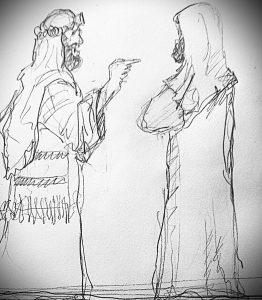
A few steps behind: Jesus is walking along the road from Galilee towards Jerusalem. As a Rabbi, we’d expect to see the disciples close on his heels, listening for his every word, relishing the light covering of dust from his sandals as they walk in his footsteps.

This scene invokes a very different image. In every sense, the disciples are not in a good place. They are in a state of ‘astonished bewilderment’ (Wm Barclay, Loc 5074). I sense that they are a few steps behind their Rabbi. Further back, beyond the disciples, there’s another anxious group of people following Jesus.

Look at the calm resolution of Jesus, stepping out with determination towards Jerusalem. It’s all the more noticeable in contrast to the palpable tension of everyone else.

I’ve told you twice: It is in Mark 8 that Peter first declares that he believes Jesus to be the Messiah. Immediately afterwards, Jesus teaches the disciples that he would be killed and rise again (Mark 8:31-33 ). The text says that ‘He spoke plainly to them about this.’ (Mark 8:32). Whatever he said, they didn’t understand. You may remember that Peter was so shocked by Jesus talking about his own death that he took him aside and told him not to say such things. Peter was rebuked by Jesus.

In Mark 9:30-32, Jesus predicts his death a second time. This time he tells them that he will be ‘delivered into the hands of men. They will kill him and on the third day he will rise.‘ (Mark 9:31Once more, the disciples didn’t understand and, perhaps because of his earlier reaction to Peter, they were not going to be asking questions.

The Third Warning: Jesus takes the disciples to one side. Once more – this is the third time – he tells them that he will be killed. This time there is more detail. He mentions Jerusalem. He says that the Chief Priest is involved. He says that he will be handed over to the Gentiles. They ‘will mock him and spit on him, flog him and kill him.’ 

‘Calmly and deliberately he tells the disciples of his coming passion at Jerusalem. One after another He describes all the leading circumstances which will attend to His death. Nothing is reserved. Nothing is kept back.’ (Ryle p156)

They sense that Jesus is resolved to accept his own death. This is not what they want to hear. It makes no sense to them.

The challenge for the disciples is this. They believe that Jesus is the Messiah. They believe that they know what the Messiah should be like. They know what he should achieve. They have been raised to anticipate this conquering hero of Israel who will restore the nation to glory. They thought that they were watching history being made. They were excited to be part of it. His violent death in Jerusalem was not on their agenda. He is supposed to be victorious – to rid Israel of the Roman invaders, not to be put to death by them.

We must try to understand the bewilderment and fear of his followers, for this was a difficult experience for them and not at all what they had planned or expected. Each new announcement of his death only added to their perplexity.’ (Wiersbe: p125)

End Piece: We shouldn’t blame the disciples for being scared. In their place, we would have been scared too. We can’t blame them for misunderstanding what to expect of the Messiah. I can imagine the whispered conversations. You can almost feel their anxiety. If Jesus’ death is approaching, what does that mean for them? Are they supposed to die alongside him? What would that achieve? Is this the end? No wonder they are bewildered. This isn’t what they signed up for. No wonder they are hanging back. No wonder they are a few steps behind Jesus.

We’re not so different. We have our own view of who Jesus is, and there are times when he doesn’t meet our expectations. We get distracted by our own life ambitions and plans. We anticipate great things. We forget that we are supposed to be following, not leading. We fall out of step, feeling anxious and bewildered. We fall back. Just like those disciples, we find ourselves feeling uneasy. We find ourselves a few steps behind where Jesus wants us to be.

Following Jesus is about moving forwards. It’s about letting Him lead. It’s about trust. It’s about confidence in Him. It’s about keeping close. He wants you to be there at his heels, ready to listen, and ready to serve. He wants you to be so close that you can feel the dust from his sandals landing on you. Straining to hear his voice. Following closely in his footsteps.

That’s what it means to follow Jesus. Don’t get left behind.

Try to keep up.

Richard Jackson, West Sussex: LifePictureUK