Tag Archives: temple

Olivet Discourse 4: ‘Destruction of the Temple’ Mark 13:14-23

Olivet Discourse 4: Mark 4: 14-23

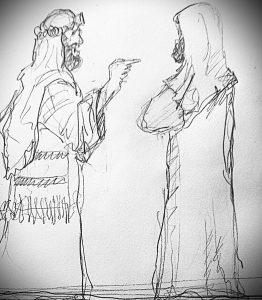
’14 When you see “the abomination that causes desolation “ standing where it does not belong, – ‘let the reader understand – then let those who are in Judea flee to the mountains 15 Let no-one on the housetop go down or enter the house to take anything out. 16 Let no one in the field go back to get their cloak. 17 How dreadful it will be in those days for pregnant women and nursing mothers! 18 Pray that this will not take place in winter, 19 because those will be days of distress unequalled from the beginning, when God created the world, until now – and never to be equalled again.

20 If the Lord had not cut short those days, no one would survive. But for the sake of the elect whom he has chosen, he has shortened them. 21 At that time if anyone says to you “Look, here is the Messiah!” or “Look , there he is!” do not believe it. 22 For false messiahs and false prophets will appear and perform signs and wonders to deceive, if possible, even the elect. 23 So be on your guard: I have told you everything in advance.

Mark 4:14-23

Destruction of the Temple
There are various interpretations of these verses. For some, this prophecy concerns the Second Coming of Christ. We’ll look at that in my next post. in this post, I’m reflecting on the interpretation which concerns the destruction of the Temple in Jerusalem.

Run for the Hills!
The first part of this chapter dealt with the coming destruction of the Temple in Jerusalem. Jesus warned of problems which will arise in the months and years to follow, but said clearly, ‘do not be alarmed!’.

There’s a real change of pace in verse 14, with the exhortation that those who are in Judaea should run for the hills. This reads rather like a fire alarm or tsunami response briefing. Do not stop to pick up your bags. Do not go back for your mobile phone. Abandon your laptop. Get out – do it now!

‘Up until this point they are to stand firm: now, at a given signal, they are to take to their heels.’ (Wright, p180)

There can be no doubt that in verses 14-23 Jesus is delivering a prophecy about the fall of Jerusalem. We know that a brutal invading army will arrive and take control of the city, including the Temple. These events came to pass in 70AD, when the Romans delivered a crushing response to the Jewish uprising of 66-70AD.

In the verses we’re looking at here, Jesus describes the signal to run. He refers to the ‘abomination which causes desolation’ (the NRSV translates this term as the ‘desolating sacrilege’), which will appear in the Temple and bring some kind of disaster on the people of Jerusalem.

‘Jesus doesn’t seem to know precisely what this [abomination] might be, but it sounds like a pagan idol, or an image of another god, in the place of the One true God, set up in the middle of the Temple.’ (Wright p181)

At a time of turmoil in the Roman empire, it was Titus, one day to become Emperor himself, who led the destructive assault on Jerusalem. The brutal invasion, during which thousands of Jews were subjected to brutal beatings, sexual violence and execution, To the Jews of Jerusalem, their experience felt like the end of the world. But in reality, it seems that Jesus is predicting the end of the Temple at Jerusalem. As we would anticipate, his prophecy was horrifically fulfilled in full measure.

End Piece
So how does a prophecy about the fall of Jerusalem speak to us today.

Christ has taught us to listen to his word and put it into practice. He warned us that we will face persecutions of all kinds (eg Luke 21:12). He prayed that we would be given strength to stand firm in our faith. Paul encourages us to stand firm in the face of adversity, in the knowledge that nothing can separate us from his love.

Yet here is an interesting turn in his teaching. As the writer of Ecclesiastes once wrote, there is a time for everything. Jesus now teaches that there is a time to run for safety.

 A believer is not to suppose that God will take care of him and provide for his needs if he does not make use of means and the common sense which God has given him as well as other people. Beyond doubt he may expect the special help of his Father in heaven in every time of need. But he must expect it in the diligent use of lawful means. To profess to love God while we idly sit still and do nothing, is nothing better than fanaticism and brings religion into contempt.

Ryle, p205

Richard Jackson, West Sussex: LifePictureUK
 

Temple Destroyed: Mark 13:1-2

The Temple Destroyed

13 As Jesus was leaving the temple, one of his disciples said to him, “Look, Teacher! What massive stones! What magnificent buildings!”
“Do you see all these great buildings?” replied Jesus. “Not one stone here will be left on another; every one will be thrown down.”

Mark 13:1-2

Horsham: 9th July 2025

The Temple which was familiar to Jesus and the Disciples is sometimes known as ‘Herod’s Temple’. It  had actually existed since 516BCE, but during the time of Christ it was undergoing renovation. The renovations had started in 18BCE under the direction of Herod the Great, but were continuing during the life of the disciples. We cannot overstate how unusual this complex and the Temple building in particular was. The Disciples could have never seen any building of anything like the size or quality of the Temple. It was truly impressive sight.

Rather than flattening the top of the hill on which Jerusalem was built,  Herod built up a vast retaining wall which surrounded the peak, and created a huge platform which became the foundation of the Temple complex. We read that some of the stones used in building the Temple were 40 feet long, 12 feet high and 18 feet wide. Parts of the building were cladded with gold, whilst other exposed stone was pure white in colour. If we were to see it as the disciples saw it, we too would exclaim ‘What magnificent buildings!’

To be told by Jesus that this awesome structure would be destroyed would have been shocking. Not one stone left upon another. Utter devastation.

In 66AD, a little less than 35 years after this conversation took place, there was an Jewish uprising against the Roman occupiers. The ensuing war and overwhelming force of the Roman empire led to the occupying forces laying siege to the city of Jerusalem in 69AD. After months of fighting, as hunger and disease became rife in the city,  the Romans eventually gained access to the Temple in 70AD. They set fire to anything which would burn, before literally taking the Temple apart, stone by stone. Whilst some small parts of the platform remained and are still visible even today, this extraordinary building was reduced to rubble. Not one stone of the temple buildings remained upon another.

The Romans continued the destruction of the entire city, killing thousands of men, women and children, with others enslaved.

End Piece

As we will see, Chapter 13 can be complex and challenging, but here at the beginning is a simple, clear prophecy from the Messiah. As we see, within a generation, to the lasting dismay of the Jewish nation, the prophecy was entirely and accurately fulfilled.

The destruction of the Temple is one of the most devastating moments of Jewish history, and is commemorated even today with the annual fast of  Tisha B’Av.

For a wonderful source of information about historical and contemporary views of Jewish history and in particular the Destruction of the Temple, click here Link to www.chabad.org).

Richard Jackson, West Sussex: LifePictureUK

Jesus Authority Questioned: Mark 11:27-33

Jesus Authority Questioned

27 They arrived again in Jerusalem, and while Jesus was walking in the temple courts, the chief priests, the teachers of the law and the elders came to him. 28 “By what authority are you doing these things?” they asked. “And who gave you authority to do this?” 29 Jesus replied, “I will ask you one question. Answer me, and I will tell you by what authority I am doing these things. 30 John’s baptism—was it from heaven, or of human origin? Tell me!”

31 They discussed it among themselves and said, “If we say, ‘From heaven,’ he will ask, ‘Then why didn’t you believe him?’ 32 But if we say, ‘Of human origin’ …” (They feared the people, for everyone held that John really was a prophet.) 33 So they answered Jesus, “We don’t know.”

Jesus said, “Neither will I tell you by what authority I am doing these things.”

Mark 11:27-33

Horsham. 27th May 2025

‘The chief priests and teachers of the Law [..] were looking for a way to kill Him, for they feared Him, but the crowd were amazed at His teaching’ Mark 11:18

Many people travelled great distances to see what was going on when John was baptising people in the River Jordan. He offered a baptism of repentance for the forgiveness of sins (Mark 1:4). What those people saw stirred them greatly. Many of them accepted John’s baptism for themselves.

In the eyes of many people, this John looked like a prophet. He dressed like a prophet. He spoke like a prophet. He acted like a prophet. Not surprisingly, vast numbers of people believed that John was a prophet sent by God. Many of them knew that this John had not only baptised Jesus, but had pointed to him as the Messiah. ‘Behold,’ he had said, ‘the Lamb of God who takes away the sins of the world.’ John had further raised the perception that he was a prophet because he had been martyred by Herod. John, however, was not recognised by the Jewish authorities. ‘Officially, they had not recognised John. So the official religious leaders kept a cool distance from the Baptist.. The crowds went to hear this preacher but the official leaders kept neutral.’ (Pawson, p.220)

Our familiarity with the story of what we call Holy Week can make us underestimate the impact of Jesus disrupting the activities at the Temple, turning over tables, releasing animals and scattering money. He presented a real challenge to the Temple authorities. They knew who he was and that his teaching was attracting a lot of people. His disruptive behaviour and his growing popularity was an affront to their authority. They needed to respond, and they needed to be seen to respond. They were already looking for ways to catch Jesus out, and to get him out of the way. They smelled an opportunity.

Their reasoning was quite straightforward. Obviously, even Jesus couldn’t be acting on his own authority. If he was, he should be arrested for causing damage. If he claimed to be acting on God’s authority, he would be arrested for blasphemy – a charge for which he could be quickly sentenced to death. Be in no doubt, they meant to kill Jesus. This was their opportunity, and they were going to take it.

The temple is packed. Jesus is teaching in the colonnades of the temple. Such is their confidence that they approach him in the midst of a crowd. They want as many people as possible to hear His blasphemous claims. The problem is, Christ’s response.

Do you remember asking a teacher a question and they answer by asking you a question? It can be really annoying. I know, because as a teacher, I do it all the time. This technique was normal practice for a Rabbi, and it was culturally appropriate to answer the rabbi and then rephrase your own question.

Jesus unexpected question causes a real dilemma. If they admit that John’s ministry was of divine origin, the crowd would be asking why they were not recognising the messianic anointing and authority of Jesus. If they say that John’s baptism was not of God, the crowd would be furious and they would themselves cause a greater disturbance than Jesus had caused the day before. They are caught in a dilemma of their own making.

The volatile crowd who they had hoped would witness the blasphemy of Jesus are now the crowd who are watching them, the temple authorities, floundering. They cannot safely answer his question. They have to publicly back down. They look weak and ineffective. Their pride is knocked. They are sinking further into the mess of their own making.

‘Those who will not face the truth have nothing but the prospect of deeper and deeper involvement in a situation which renders them helpless and ineffective. (Barclay, Loc 5648)’

They were intent of ridding themselves of this turbulent rabbi before, they are determined to do so now.

This is not over.

End piece

We know that as his ministry progressed, Christ’s teaching was increasingly oppositional to the existing power structures of Israel. Those in authority didn’t particularly care whether he was right or wrong. They saw him as a threat to their power, and they wanted rid of him. They were ready to use any tricks they could to do so. They were ready to ignore the constraints imposed upon them by the Law.

An animal is dangerous if it is injured. Powerful men are rarely more dangerous than when the injury is to their pride.

In time honoured tradition, they dismissed his teaching as fake news. They tried ignoring Him. They tried threatening Him. They tried to stir up opposition against Him. They tried cancelling Him. Now, they want to silence him. They are determined. They will succeed.

Fake news. Cancel culture. Abuse of authority. All sounds rather familiar.

‘What has been will be again, what has been done will be done again; there is nothing new under the sun.’ (Ecclesiastes 1:9)


Have Faith in God: Mark 11:22-25

22 ‘Have faith in God,’ Jesus answered. 23 ‘Truly I tell you, if anyone says to this mountain, “Go, throw yourself into the sea,” and does not doubt in their heart but believes that what they say will happen, it will be done for them. 24 Therefore I tell you, whatever you ask for in prayer, believe that you have received it, and it will be yours. 25 And when you stand praying, if you hold anything against anyone, forgive them, so that your Father in heaven may forgive you your sins.’ 

Mark 11: 22-25

Horsham: 19th May 2025

How did we get here?:
These verses follow the discovery by the disciples that the fig tree which had, hours earlier, been cursed by Jesus is now dead (vv 20-21). Our familiarity with the story is such that we can thoughtlessly say ‘the fig tree died’, without pausing to notice the extraordinary supernatural power which lies behind that phrase. Finding that the tree had died so quickly must have left those who had witnessed the event profoundly impacted. In their astonishment, the disciples look to Jesus for an explanation.

Have Faith in God:
Jesus answer is simple, direct and foundational to the teaching which follows. ‘Have faith in God‘ (v22).  Those who walk in the light of the Kingdom, who pray in simple faith, believing in their hearts that nothing is impossible for God, will see powerful and extraordinary answers to their petitions.

William Barclay points out that the claim that faith can move mountains (v23) is common in rabbinic teaching, and appears in Matthew 17:20 and in similar form in Luke 17:6. In each of these instances, the context is different. This saying was never intended to be taken literally. It means that prayer, prayed in faith – faith in the Almighty, all powerful God, can resolve even the greatest of challenges.

Barclay suggests, we might assume that these verses contain phrases which were common sayings of Jesus (Barclay Loc:5562). 

Effective Prayer
First, pray in a spirit of faith, believing that God will answer your prayer (v24). Of course, this assumes that we are doing all that we can to live in God’s will, and that this passion is reflected in our prayers.

Secondly, but just as important, comes the need for forgiveness (v25).

‘And when you stand praying, if you hold anything against anyone, forgive them, so that your father in heaven may forgive your sins.’ (v25)

There is an echo here of Christ’s familiar teaching on prayer. This, he once said, is how we should pray:

‘Forgive us our sins, as we forgive those who sin against us.’ (Matthew 6:12)

But there is something more. Here’s a hugely important lesson.  Forgiveness of others, says Jesus, is an essential pre-requisite for effective prayer.

Context:
So, great teaching, but why has Mark included these teachings at this point in his narrative? What is his context? Mark has just taken us through the incident with the fig tree and the clearing of the temple, both highly symbolic and dramatic parables. The response of the disciples to the sudden death of a fig tree leads Christ to point out that they have failed to grasp the potential supernatural power of prayer.  Rather than being randomly placed alongside these two familiar stories, these teachings are relevant to the theme of his unfolding narrative.

End Piece:
The Apostle Paul tells us to ‘pray constantly’ (1 Thessalonians 5:16-18). If we want to make a difference in this broken world, we must learn how to pray effectively. Pray believing in the supernatural power of prayer. Pray in faith. Pray in confidence. Pray with a thankful and forgiving heart. The forgiving heart, says Jesus, is critical.

‘Perhaps only those who have learnt what that means will be in a position to act with Jesus’ authority against the injustice and wickedness of our own day.’ NT Wright, p151

Richard Jackson, West Sussex: LifePictureUK

Fig Tree and Temple 3: Clearing the Temple Mark 11:15-18

15 On reaching Jerusalem, Jesus entered the temple courts and began driving out those who were buying and selling there. He overturned the tables of the money changers and the benches of those selling doves, 16 and would not allow anyone to carry merchandise through the temple courts. 17 And as he taught them, he said, “Is it not written: ‘My house will be called a house of prayer for all nations? But you have made it ‘a den of robbers.’ 18 The chief priests and the teachers of the law heard this and began looking for a way to kill him, for they feared him, because the whole crowd was amazed at his teaching.

Mark 11: 15-18

17th March 2025: Horsham

(Published on the Crossblog on 30th April 2025)

Jesus has walked the three or four miles from Bethany to the city of Jerusalem. As he left the village, Jesus had effectively put a curse on an apparently healthy fig tree which had provided no fruit. By the time he and his disciples return later that day, the tree will be dead.

His destination is Jerusalem. The Temple. When he arrives, he is  frustrated by the commercial activities taking place in the Temple Courts. I want us to think about what was going on and why.

The Pilgrims: The time of the Passover festival is approaching. The population of Jerusalem is hugely swollen by the arrival of hundreds of thousands of pilgrims. Some have come from the towns and villages around Jerusalem, but many have travelled long distances from around Israel and beyond. For all of them, their destination is the Temple.

Their pilgrimage is spiritual. It’s about spiritual celebration and service. They are there to worship God. That means sacrifice, offering and prayer. For sacrifice they need animals and they must be in peak condition. They need money to pay the temple tax and make offerings. These things can only be sorted at the Temple. In the outer court – the Court of the Gentiles – money can be changed and animals purchased. When Jesus arrives, this Court is full of noise and bustle, focused around the market – the money changers and the animal traders.

There is little space for quiet. Little space for prayer. The traders and the Temple authorities are making money from the market activities. ‘The Court of the Gentiles should have been a place of praying, but it was instead a place for preying and paying.’ (Wiersbe, p.136)

The Traders: Every animal presented for sacrifice has to be in perfect condition. If it is not up to standard, it will be rejected by the priests. Quite clearly, a sheep which has been driven through the wilderness and along dusty roads will not be in the best condition when it arrives at the Temple. Everyone knows that to pass the scrutiny of the priests, it was necessary to buy your animal in Jerusalem. For this purpose, the court of the gentiles, a large public area surrounding the temple itself, had developed into a livestock market, offering certified lambs, oxen and doves. Certfied as suitable for sacrifice. Of course, in the Temple market, the ‘captive audience’ creates the opportunity to inflate the cost of animals. In some cases, those who are poor can offer a dove in sacrifice in lieu of a lamb. There are records of the Chief Priests controlling the prices to minimise the risk of selling doves at extortionate prices to the poorest worshippers, but it does happen. For Jesus and his family this was nothing new. When Christ was born, Mary and Joseph offered two doves (Luke 2:22-24).

The Money Changers: Most of the worshippers are from Israel, so why the need for money changers? The answer is quite simple. The temple has its own currency. Pilgrims need to pay tax at the temple and the only money which was accepted was the Tyrian Shekel. These coins, originally minted in the city of Tyre, are now produced in Judea under license from the Romans. They can only be used within the Temple compound. One feature of the Tyrean shekel is that it had an unusually high silver content and so the value was consistent and clear to everyone. Exchange rates were set by the traders themselves and so there was profit to be made at the expense of pilgrims.

The Temple Authorities: The market is controlled by the Temple authorities, and one reason for high prices is that animal sellers and money changers are required to pay a fee to these authorities to get a license to sell. There is some  evidence that the Temple authorities deliberately inflated prices, but there is also evidence that at times they were instrumental in reducing the burden on pilgrims by driving prices down (for an example see the actions of Rabbi Ben Gamaliel to reduce the price of doves, recorded in the Mishnah, Kerithoth 1:7).

Jesus actions: You’ll know the story. Jesus has very strong views about what is going on. He starts turning over tables of money changers and dove sellers. ‘Is it not written that my temple shall be a house of prayer for all nations!’ (Isaiah 56:7) ‘But you have made it a den of robbers.’ (Jeremiah 7:11). Jesus is really saying, this is the Temple and God expects his people to be producing fruit. In reality, rather than encouraging worship and upholding the Law, the authorities were continuing a situation where space was given to lucrative commerce rather than prayer. Instead of facilitating heartfelt worship, the focus is on making money from it.

The Result: There were several reasons why Christ’s action would have upset the authorities. There was a momentary interruption to cash flow. There is a need to keep control – to be seen to respond to this outrageous behaviour of a Rabbi. A riot in the temple courts will attract the attention, even the intervention of the Romans.  Perhaps worst of all, the people were excited, and attracted to Jesus. Many of them were there when he entered the city, riding a donkey. Many of them had heard that this was the Messiah, and they want it to be true. In this moment, he is clearly, and very publicly, attacking the authorities.  They are, after all, the overseers of the whole thing. So many reasons for the Jewish leaders to want to be rid of him.

End Piece: This was not the first time Jesus had visited the temple. The practices of the market place in the Temple had developed over many generations. It’s easy for us to be critical of the situation that provoked Jesus to take action, but to everyone involved, including the pilgrims, that was just the way things had always worked. The vast majority of people didn’t even notice that they were doing anything wrong, and maybe that’s what really annoyed Jesus.

The real message here is that Israel is not fulfilling it’s purpose before God. The healthy looking fig tree is failing to produce even those small immature fruit which might have been available at this time of year. The fig tree is symbolic of Israel. Like the fig tree, Israel itself is at risk of finding itself deeply out of favour with God.

From time to time we wonder how Jesus would react if he walked into our Church. Maybe, rather than condemning the money changers, animal traders and temple authorities, it might be more fruitful to reflect on what is going on in our own Churches and our own way of life.  If Jesus walked into your world right now, what might attract his attention? (Matthew 7:3-5)

Richard Jackson, West Sussex: LifePictureUK

Fig Tree and Temple 1: The Markan Sandwich – Mark 11: 12-25

Horsham: 4th March 2025

(Published on The Crossblog 30th April)

You may come across a reference in a commentary or sermon to an aspect of Mark’s style which we call the ‘Markan Sandwich’. This is a literary device in which the writer starts to tell a story. After a short paragraph of introduction, he moves to a second story, before returning to conclude the first narrative. At first glance, the two stories may seem entirely unrelated to each other, but invariably they work together to make or emphasise a point. ‘The middle story nearly always provides the key to the theological purpose of the sandwich.’ (Dr Tim White).

The Sandwich: The ‘Markan sandwich’ device appears 7 times in Mark’s gospel (see the list at the end of this post). In these verses, Mark 11: 12-25,  we have a great example. Mark introduces the story of the fig tree which offers no fruit. He then relates the story of Christ clearing the temple, before returning to the conclusion of the story of the fig tree. We’re going to look at each of these stories, but first, let’s look at the link between them.

The Fig Tree: The fig tree should be able to deliver small fruits which would feed Jesus. These are not mature figs, but a kind of bud, referred to as a ‘breba’ in Spain, or a ‘taqsh’ in arabic countries. These small buds, which do not develop into full figs, appear in the cooler months of spring and are edible. They’re not a great delicacy, but if you were hungry, you would eat them.

This tree looks as if it should be capable of producing fruit. On close inspection, it offers nothing.

The Temple: In the Jewish mind, temple was a place of worship and sacrifice. Jesus reacted strongly to the corrupt commercial market which was being held within its’ walls. The market was the only, or at least the most visible, activity in the temple courts.

The temple looked as if it was capable of producing fruit for God, but on close inspection, Jesus found that it was failing in its purpose. The main activity was buying, selling and money changing, with some traders taking advantage of the many pilgrims and visitors.

The Link: Let’s start by noting that the Jews regarded the fig tree as symbolic of Israel. This is rooted in Old Testament imagery.

The fig tree’s fruitfulness is a metaphor for the nation’s blessing and favor from God. Conversely, the absence or destruction of fig trees symbolizes judgment and desolation. (see BibleHub commentary: ‘Symbolism of the Fig Tree)

We’ve already noticed that both the fig tree (which somehow represents Israel) and the temple (which should be the beating heart of Israel) are failing to produce fruit which is at the core of their created purpose.  Consequently, both are condemned by Christ. The destruction of the fig tree is immediate. In context, we see a performative parable which prophecies the destruction of the temple. That destruction is just as real and takes place at the hands of the Romans, nearly 40 years later.

The Lesson: In context, these two stories sit perfectly together and contribute to a single purpose. The lesson is simple. The follower of Jesus must produce fruit for the kingdom. That is our purpose. In these performative parables, Jesus criticises those who look as if they are being effective, but in reality they are not. Each of us, and every Church of every generation, needs to sit up and take note.

‘I know your deeds. You have a reputation for being alive, but you are dead!’ (Revelation 3:1)

Richard Jackson, West Sussex: LifePictureUK

For a simple but detailed review of the ‘Markan Sandwich’, see article by Dr Tim White, Professor of Ministry and Theology, Carolina University. 

The seven examples of the Markan Sandwich

Mark 5:21-43: The story of Jairus and the woman with the hemorrage;

Mark 6:7-30: The sending out of the Twelve and the death of John the Baptist.

Mark 11:12-21: The condemnation of the fig tree and the clearing of the temple;

Mark 14:1-11: The Plot to kill Jesus, including Judas’ betrayal, and the anointing of Jesus at Bethany

Mark 14:17-31 Christ’s prediction of his betrayal by Judas and Peter, and the Last Supper

Mark 14:53-72 Peter in the courtyard of the High Priest and interrogation of Jesus

Mark 15:40-16:8 The women at the cross and the tomb, and Christ’s body claimed by Joseph of Arimathea