Category Archives: Contemplative

Expect the Unexpected.. Ephesians 3:20

9th February 2025: Sydney, Australia

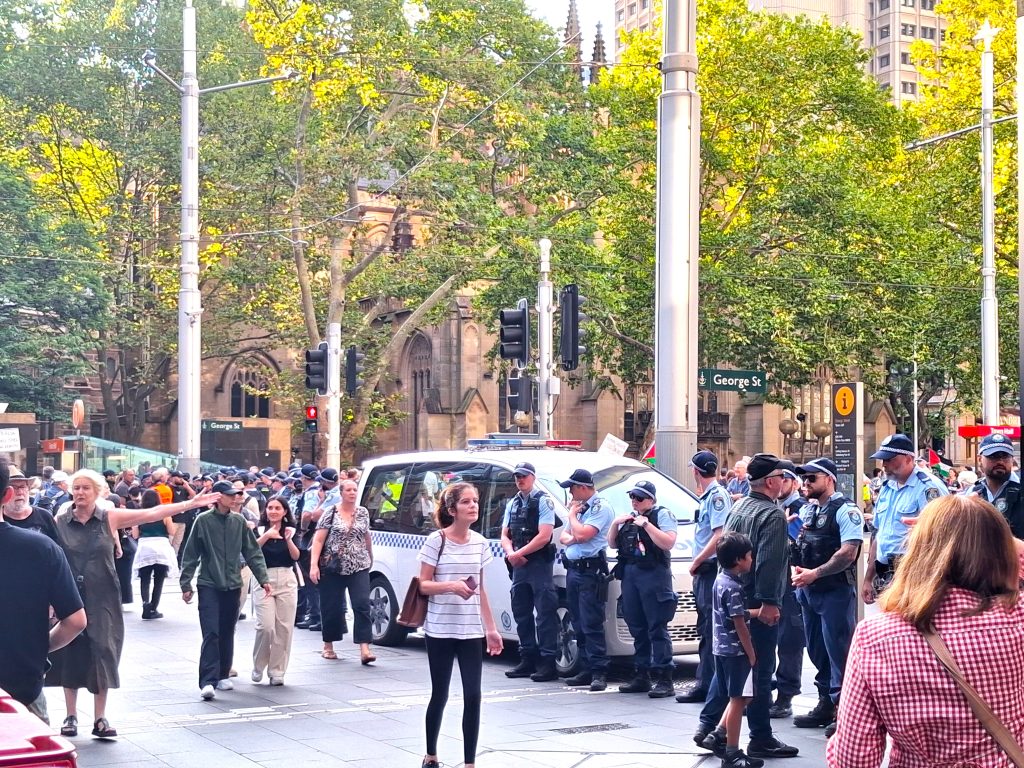
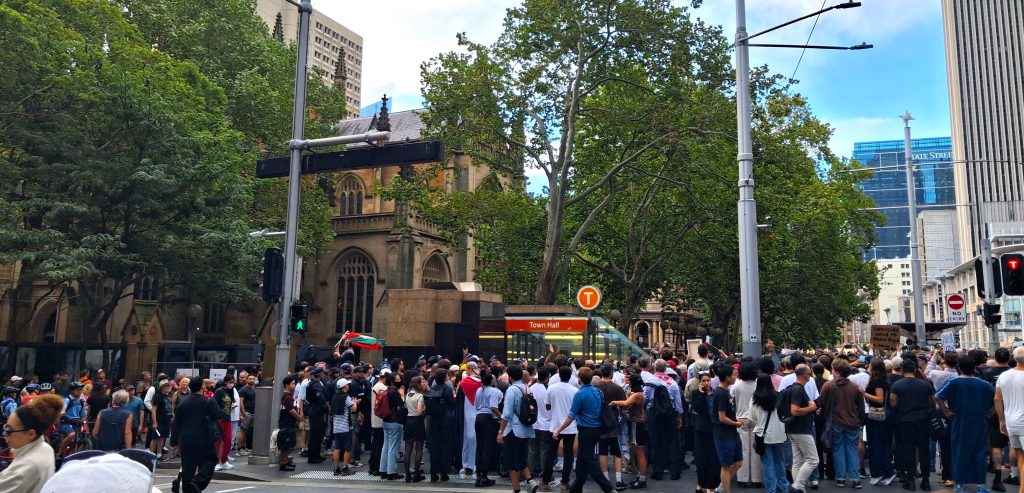
Having taken a couple of days in Sydney to recover from jet lag, it seemed good to start the reflective part of my trip to Australia and New Zealand by visiting St Andrews Cathedral for evening prayer. I obviously expected a quiet and reflective service, in the refined atmosphere of a  Cathedral. Something of a surprise, then, to find that before i could even get to the Cathedral precinct, I had to cross a police line. Next, I had to make my way through a large and vociferous crowd who were surrounding the Cathedral, raising their voices in objecting to the presence in Sydney of President Herzog of Israel.  When following Jesus, always expect the unexpected!

It was good to be welcomed by Sandy Grant, Dean of the Cathedral,  as in the background, a speaker was  demanding an end to the ongoing Israeli abuses in Gaza and the West Bank, a matter close to my own heart.

With the Cathedral PA system turned up to the max, Evening Prayer continued as planned, with a congregation of sixty or more, led by Jonathan Adams, the Precentor. The cheering and chanting continued outside, along with the persistent thrumming of the police helicopter, at times just a few hundred feet above the Cathedral.

The point is that I went to St Andrews Cathedral expecting a familiar, peaceful and contemplative experience – a moment of contemplation and encouragement as I begin my personal journey of retreat over the next few weeks. In the event, I received much more than that. I found something much deeper, much more profound. I sensed God’s presence, not because of my expectations, but in spite of them. 

As I made my way out of the Cathedral after the service, through the growing and increasingly noisy crowd, and escorted through the police line, I was reminded that when we seek God, he meets us on His terms, not ours. He meets us in His way, and not always in the way we had expected. The real lesson for me, was in the reminder I am called to be in some way His presence in this world. I was reminded that our faith is utterly inseparable from the world around us.

This was the first day of my personal journey of retreat in Australia and New Zealand. I encountered the God who gave me much more than I had asked or imagined (Ephesians 3:20).

I’ll take that.

Richard Jackson: Horsham,West Sussex

I am hugely grateful for the commitment and courage of the Dean, Precentor, Cathedral Team and the people of St Andrews for keeping the Cathedral open and going ahead with an open service of Evening Prayer on a day when it would have been easy to cancel the event or move it to a private space.   

Christ the King 2025

Horsham: 26th November 2025

23rd November was the last Sunday before the start of Advent, the season when we look forward to the coming of Jesus as a baby. For many Churches across the world, last Sunday was also a  celebration of ‘Christ the King’.  So, preparing to preach at a local Church in Horsham it seemed a bit of a challenge that the Lectionary gospel reading for that day was Luke 23: 33-43, which is the story of the execution of Jesus alongside two criminals.

At first sight, this reading from Luke sits uneasily in the week before advent. Advent is about birth. The reading is about death. The advent themes are, after all, hope, peace, joy and love. Reminding ourselves at this point of his death somehow sets a grotesque spoiler alert to the anticipated birth of a child.

But of course, this reading is here exactly because it reminds us that this baby, this helpless child, is Immanuel, the Son of God. This child is the lamb of God who, through this act of supreme sacrifice, will take away the sins of the world.

So what about the celebration of  ‘Christ the King’? To celebrate that you might expect us to read the story of the triumphal entry into Jerusalem, or perhaps a reading from Revelation, showing Christ as truly shown as King – Christ in glory, filled with power and authority, ready to establish the New Jerusalem. And yet we had our reading about the death of our King. The crucifixion of Christ.

Again, it seemed to sit awkwardly against the celebration of Christ the King.

Looking at things differently

I think that we need to look at this story differently – like picking it up and looking at it from a different angle. Fortunately there were a couple of witnesses who, alongside the Pharisees, and a bunch of Christ’s family and friends, were there.

You may remember that one of the criminals who was dying alongside Jesus, turned to him and said ‘Jesus, remember me when you come into your kingdom.’ Somehow, he has noticed something that other people might have missed. For Jesus, this is not the end. Indeed, his death opens the opportunity for a new beginning. Without his death, there could have been no resurrection.

There was one more unexpected witness to these events. The centurion who headed the squad who have carried out the execution and been responsible for crowd control (Matthew 27, Mark 15). This man had watched Jesus die. This man was used to seeing violent death up close and personal, and yet he had seen something that others might have missed. He looked upon the body of Christ and said ‘Surely, this man was the Son of God’.

Hope.. Peace.. Joy.. Love..

We might start to see that this is a story which gives us hope, because by his sacrifice Christ has indeed come into his kingdom.

It is a story which should give us peace, because we know that this is indeed King Jesus, the Son of God. The voice of the criminal alongside him reminds us that this was not the end for Jesus. In a sense, it heralds a new beginning in his Kingdom. He is truly Immanuel, God with Us in His resurrection.

And it is a story through which we know that Christ has conquered death, that we have the hope of salvation, because we share in the joy of his resurrection.

It is a story of sacrificial love, the shedding of blood and the breaking of his body for the forgiveness of sin, for me – for you!

This is not the end..

Christ is King, but his Kingdom is more than this! The fact that, in reality this was not the end, that on the third day Jesus was raised from the dead and is, by the power of the Holy Spirit amongst us now, gives us the confidence to have hope in our own resurrection and salvation to eternal life  with Christ.

For surely, the baby whose birth is celebrated at Christmas, becomes this man who is crucified 33 years later. This man was, and is, Christ the King. Truly this man is the Son of God.

Lord Jesus. Remember me when you come into your Kingdom.

Richard Jackson, West Sussex: LifePictureUK


Halloween 2025

It’s that time of year again. Let’s talk about Halloween.

“UK Spending on Halloween 2025 likely to be £779 million”

I was astonished to read that when the accounts are done, spending in the UK on Halloween this year is likely to be in the region of £779 million. That’s quite a lot of money. I found some other stats which suggested that  we could build two small hospitals for that. So, great! There’s one more reason for us Christians to grumble, mostly quietly in the background, about Halloween.

Personally, I’m not grumbling. And I don’t think you should either.

At a level, I can understand why some Christians become hugely exercised about the ‘darkness’ of Halloween. I mean I don’t think for one moment that encouraging small children to think about the ‘spooky’ is particularly helpful. But it seems to me that many Christian opponents of Halloween in the UK struggle to explain exactly what the problem is.

I’m sometimes told that Halloween is a time when people look for, are open to, and dabble with the things of evil. If that’s true, it’s probably not a great thing. But is that really what’s going on when people fill their supermarket with inedible pumpkins and tacky skeleton costumes? Are my neighbour’s really dabbling in evil when they hold a fancy dress party?

“The only really bad thing about Halloween in the UK is the wicked waste of money!”

Personally, I’m not so sure. For me, the only really bad thing about the way we do Halloween in the UK is the wicked waste of money.

A recent YouGov poll suggests that only 28% of Brits take any real interest in Halloween.  So maybe we should all take a breath and think about what’s really going on here.

Halloween is the one time of the year when people, young and old, are encouraged to think about death (spooky skeletons), the after life (freaky ghosts), and the supernatural (things that go bump in the dark). 

“for Christian people, one of the worst things about Halloween in the UK might be the missed opportunity”

Setting aside the spooky skeletons, freaky ghosts and things that go bump in the dark, there is surely an opportunity for Christian’s here.  Personal mortality, the after-life, the supernatural power of the Holy Spirit – these things are at the heart of what we want to be talking about. Could it be that for Christian people, one of the worst things about Halloween in the UK might be the missed opportunity to quietly and confidently get involved in conversations about our faith.

The YouGov data, suggests that up to 72% of Brits have little active interest in Halloween anyway. If that’s true, maybe it really is time to take yet another deep breath and focus on looking for the opportunities to talk about life and death, and the light of Christ, which dispels darkness. Halloween, it seems to me, is a time to get ready to pick up on conversations wherever we can to talk about the transformational love of Jesus.

Jesus said that he is the light of the world (John 8:12).  He calls you to reflect that light to others (Matthew 5:14). Don’t let’s dwell on the darkness. Let’s get out there and talk about the light.

“God is light; in him there is no darkness at all.” 1 John 1:5

Be encouraged. Happy Halloween.

Richard Jackson, West Sussex: LifePictureUK

Alternative views..

Crossblog post: Halloween / Samhain (Published 2024)

Christianity Today article ‘Should Christian’s Celebrate Halloween’ (Published October 2025)

Facebook  of evangelist J John. Check out his Halloween post on 28th October 2025.

October 7th 2025: Anniversary

Israel
Two years ago today, we watched in horror as Israeli citizens in the area known as the Gaza envelope in the southern district of Israel, close to the Gaza border, suffered appalling attacks. A correspondent to the BBC, the father of a child survivor of kidnapping,  quite reasonably described this as the greatest attack on Jewish people since the holocaust. 

In a few short hours, 4300 rockets were launched from Gaza into Israel. 21 communities were murderously attacked by around 7000 Hamas fighters who had ‘broken out’ of Gaza.

The stories of pain and human suffering which emerged over the following days were horrific and heartbreaking. 1182 people, mostly civilians, died in those attacks, including 38 children. 70 of the casualties were Arab Israeli’s. Words like slaughter and massacre are appropriate. Nearly 3500 more people were injured. There were many reports of beatings and rape. 247 people were kidnapped, trafficked and detained in Gaza, from where many of them will never return.  

Nothing can be said or written to justify what happened on that day in October, or the continued suffering of hostages of any other victim.

Tens of thousands of Israeli’s carry the emotional scars of loss, bereavement, uncertainty, and watching the ongoing suffering if people they love. For most, the scars of what happened on that day will never heal. The harsh blanket of despair covers a much wider proportion of humanity  than just those who were killed and injured on October 7th. 

Along with the people of Israel, and the global Jewish community, we should raise our voices once more in condemnation of the senseless brutality of those attacks. We should remember that every single victim had a name. We should pause today to mourn each and every one. We should pray for those who continue to suffer, and for those who mourn.

Gaza
Today marks 2 years since the start of the Israeli response to those brutal attacks. The response has been devastating and unrelenting. 

Since October 7th 2023, in response to the Hamas attack, at least 67,000 residents of Gaza have been killed by Israeli action. In many areas of Gaza, the destruction is so severe, that these figures may underestimate the total. 20,000 of those casualties were children – one child for each hour since 7th October 2023. The IDF claim that 12,000 Hamas fighters are amongst the dead, although that figure is unlikely to be confirmed. Words like slaughter and genocide are appropriate. 169,000 people have been injured as a result of Israeli action. It is suggested that up to 40,000 people are facing life changing injuries, with up to 21,000 children permanently disabled. The position for children in Gaza is beyond horrific.

The deliberate targeting of hospitals is a war crime. In Gaza, more than 100 hospitals have been destroyed or damaged beyond use by Israeli bombs.  Doctors, including senior surgeons, have been ‘arrested’ and transported to Israel to prevent them treating their own people. Journalists have been specifically targeted and murdered to prevent them communicating the horrors of everyday life in Gaza and the actions of the IDF.

As part of their military operation, Israel have blocked virtually all food, water and medical aid from entering Gaza. These tactics are medieval. They are indefensible. UNICEF figures say that in mid September 2025, 12,500 children (1 in 5 of the population) were acutely malnourished, and by the end of September, 459 people, including 154 children have died of malnutrition. They have starved to death. Many more will die unless they are provided with managed recovery from malnutrition. 

Like the victims of the Hamas attack in Israel, every man, woman and child in Gaza has a family, often extending beyond the borders of Gaza. Once more, there is a great multitude of people who are in agony and despair for the suffering of people they love. Meanwhile, the bombs continue to fall and the numbers of dead and injured continue to rise.

Along with the people of Palestine, we should raise our voices once more in condemnation of the senseless and barbaric attacks visited upon them by Israel under the leadership and direction of Benjamin Netanyahu. We should remember that every single victim had a name, and we should pause today to mourn each and every one. We should pray for those who continue to suffer, and especially for those who mourn.

Peace Process
We hope and pray that the current peace process is successful in bringing about a cessation of hostilities, the delivery of aid to Gaza, the release of all of the hostages, and a lasting peace.

It’s difficult to be optimistic.

United States
Yesterday, the President of the United States, who believes that he should receive the Nobel peace prize for resolving world conflicts,  was asked by a CNN journalist in a ‘text’ interview, what would be the response if Hamas refused to accept his latest peace deal. 

He replied with two words. ‘Complete obliteration’. 

Keep praying.

Tragedies, Statistics and Real People

Tragedies, Statistics and Real People

There is an apocryphal story which was sometimes told in Stalin’s Russia.

‘In Russia,’ the story goes, ‘it was often said that if there is an accident and three people are killed it is a tragedy. Yet if tens of thousands of people are deported or executed, that’s a statistic.

Israel, Gaza, Ukraine, Russia, Armenia, Sudan, Eritrea, Yemen, Democratic Republic of Congo. The list, right now, seems endless. Our news feeds are full of horrific news, often presented as statistics. How easily we can become de-sensitised by statistics. We easily overlook the fact that behind every death, every injury is a real person. Therein lies the real tragedy.

Behind every individual number is a personal story. A maelstrom of physical and emotional trauma f or the victim, their family and their community.

As Christ wept over Jerusalem, so must we pray and stand up for nations and cities in their time of need. Christ looked upon the needy crowd and had compassion on them, and in our day so must we. Yet Christ dealt with individuals. He touched, blessed, encouraged and healed real people. And so must we.

Christ didn’t deal with statistics. He loved people for who they were. And so must we.

Richard Jackson, West Sussex: LifePictureUK

Adversity: A Reflection

A Reflection about Adversity. 

When times are really bad, you will discover who your real friend is.
It will be someone  in whom you have invested time and energy.
Someone to whom you have given space and time.
You have confided in them – your hopes, your fears, your burdens:
You have made time to listen to them.
They have put up with you
They have challenged you 
Sometimes they have chided you.
Occasionally, you will have felt let down by them and you may even have turned your back on them
But later, when you felt the time was right, they have welcomed you back.
Their friendship has been strong. 
Their love has been profound.
They have encouraged you.
You have walked together through good times and bad.
That is the friend who will be there for you.
The One who will stand with you.

When you need them most, may you have such a friend as this.
May His name be Jesus.

August 2025, Horsham

Richard Jackson, West Sussex: LifePictureUK

Twenty Years On: 7th July, 2005

7th July 2005 started like any normal day.

I arrived at work early, as I usually did. I had travelled for a couple of hours from Essex, across the London Underground network to Kennington in South London.

Around 8.45am, I walked into the canteen and heard mention of some kind of power surge which had stopped parts of the Underground. I was interested, but not greatly concerned. My 19 year old daughter was also working in south London, and would be travelling through central London about then. She was used to the Underground. She’d be fine.

Then the story started to change. It wasn’t a power surge. It was an explosion. I rushed to New Scotland Yard to support the senior management team to whom I was Staff Officer. My major incident role.

I was in on the first briefings. Multiple explosions. Someone mentioned five stations affected. Sky News had mentioned Liverpool Street. My daughter would have been travelling through Liverpool Street. Now I was concerned. (It later turned out that there were three stations directly impacted. Liverpool Street was not one of them).

Next briefing. Terrorism. Suicide bombers. Three stations. A bus explosion in Tavistock Square. Many casualties. The entire public transport system of London was completely suspended. The public were told to stay where they were. This was not a normal day.

That morning, I held my breath. Everybody in London did.  We all dreaded the news that someone we loved was amongst the casualties.  My daughter wasn’t. She arrived at her office late. She was distressed, but she was ok. She was one of the lucky ones. And so was I. For thousands of others, a devastating nightmare had started. For too many, it would be a life sentence.

52 dead. 700 injured, many with life changing wounds. Every one of them loved – cherished – by family and friends. Thousands more emotionally scarred by being involved in some way. Passengers. First responders. London Underground staff. Most just did what they had to do, then walked away.

Today, I’ve heard some extraordinary stories. There was a desperately moving moment when the names of those who lost their lives were read out by survivors and relatives in St Paul’s Cathedral, voices breaking with emotion.

Today, twenty years on, we remembered. Today I rediscovered my  immense, overwhelming sadness for those for whom the nightmare started on 7th July 2025. A day which had started as such a normal day.

Today, I remembered that we were amongst the lucky ones. The lucky ones have no right to forget how lucky they are.

Richard Jackson, West Sussex: LifePictureUK

#BTW: Good Friday

Milton Keynes: 18th April 2025

I’ve had a great week but I have been on the road a lot. Last night I found myself staying at a hotel in Milton Keynes. I use this place fairly frequently, and it’s normally reasonably quiet. This, however, is Good Friday. The Easter break. Quiet it was not!

Breakfast Time…
This morning, the breakfast room was very busy. There were lots of families, teenagers, grandparents. and  smattering of individuals and couples. Loads of people were browsing their phones, or tablets. One or two business people were keeping their heads down, tapping away at laptops. Not the quiet breakfast I had anticipated.

So, there I was with my second cup of coffee. I was reading the bible on my phone.  I was using Bible Gateway (other apps are available). I read the Good Friday passages in all four gospels. Well done me. Treasure in heaven.

I looked around the room, at all the busy-ness and chatter going on around me, people rushing backwards and forwards with drinks and plates of food. It occurred to me with a sense of heaviness that I might be the only person on this room who would even notice that would open my bible today.

Lesson One …
As I was reflecting on all this, I had this image of myself sitting alone in that breakfast room in a place of absolute stillness. I saw myself in focus, whilst all this other stuff went on around me in an out of focus blur. It was a special picture which sort of created an awareness of Christ’s presence in that room. (Psalm 46:10). God is there. Even in the busiest places.

It was a reassuring image. It felt good. Moments like that give me confidence. They build me up. But they occasionally have a context. Sometimes they have an edge.

Lesson 2 …
A short while later, I went for a walk and reflected prayerfully on this image I had seen. In my mind, I looked around again at the people in the room who were not reading the Bible. In my spirit, God sort of asked me who I thought I was to judge them? He reminded me that whatever I might think, His heart is for every one of these people. From the youngest (there was an adorable three month old baby very close by)  to the oldest (I was far from being the oldest). He reminded me that I am a very average judge of character. He reminded me that I knew nothing about these people or their relationship with Him. I am looking at them from the outside. Only he can see their hearts. (1 Samuel 16:7b) When will I learn? Ouch!

Lesson 3 …
Then, he kind of showed me the image again. This time it was sort of reversed. I was part of the rush and bustle. I was in the blur. Passing  the table where I had been sitting I saw myself as others would have seen me. ‘What do you see? Do you see an angel? Do you see a great and  unmissable witness to God’s saving grace?’ 

No. What I saw was a man in late middle age, sitting in a hotel breakfast room, surrounded by the debris of his breakfast, sipping a luke warm cup of coffee, browsing his phone. He didn’t look particularly happy. A man looking, now I come to think about it, pretty much like everyone else. (Do not think of yourself more highly than you ought: Romans 12:3)

The End Piece …
Well done me? Treasure in heaven? Maybe not!

One cup of coffee. Three lessons. I am a work in progress.

Richard Jackson, West Sussex: LifePictureUK


John Rogers: Martyr

4th February 2025: Horsham

I’ve been reminded today of the life and death of John Rogers. Rogers was an English protestant theologian who died as a martyr 170 years ago today. Whilst not a household name, Rogers was an important and influential figure in the history of biblical translation.

Rogers spent time in Antwerp and northern Germany working as a pastor and biblical scholar. He was acquainted with Tyndale and other European Reformation leaders, and developed a strong reputation as a translator of biblical texts.

Matthew Bible: Rogers is credited with the compilation of the ‘Matthew Bible’, so called because it was published under the assumed pen name of ‘Thomas Matthews’. 1500 copies of the work were printed and circulated in 1537. Having returned to England in 1548, during the reign of King Edward VI, Rogers was appointed as Prebendary of St Pancras at St Paul’s, London.

In 1553, following the Coronation of Queen Mary, Rogers reportedly preached against the return to the Catholic tradition which was being imposed at the direction of Mary. The new administration deemed his speech to be heretical and Rogers was arrested. Following a lengthy period of house arrest he was moved to Newgate prison in London, where he was charged with heresy. After his conviction in January 1555, he was condemned to death. Rogers was executed by burning at Smithfield on the morning of 4th February 1555.

End Piece: We easily lose track of how significant the translation of the Bible into European languages was for the development of the protestant Christian faith. John Rogers was one of many people who paid the ultimate price during the turbulent 16th Century to make the Scriptures available and accessible in living languages. His work contributed to the seismic shift in the relationship between the Church and society. We live in a culture where anyone who wants to read the Bible in their own language can do so. It’s good to remind ourselves that it wasn’t always so.

John Rogers rejected the opportunity of avoiding the death penalty by publicly recanting his protestant beliefs. He chose to cheerfully embrace martyrdom to demonstrate his beliefs and his commitment to making the Word of God accessible in the English language.

On his way to this death, Rogers was forced to pass his wife and ten of his eleven surviving children, but not permitted to speak to them. He was the first of 287 people, including 56 women, who were executed by fire, the penalty for heresy, during the 5 year reign of ‘Bloody Mary’.

Richard Jackson, West Sussex: LifePictureUK

Source: Foxes Book of Martyrs & Oxford Dictionary of National Biography

Accessible Information about the Reformation period in England and events leading up to the arrest of John Rogers is here.