
Peter Disowns Jesus
66 While Peter was below in the courtyard, one of the servant girls of the high priest came by. 67 When she saw Peter warming himself, she looked closely at him.
“You also were with that Nazarene, Jesus,” she said.
68 But he denied it. “I don’t know or understand what you’re talking about,” he said, and went out into the entryway.[g]
69 When the servant girl saw him there, she said again to those standing around, “This fellow is one of them.” 70 Again he denied it.
After a little while, those standing near said to Peter, “Surely you are one of them, for you are a Galilean.”
71 He began to call down curses, and he swore to them, “I don’t know this man you’re talking about.”
72 Immediately the rooster crowed the second time.[h] Then Peter remembered the word Jesus had spoken to him: “Before the rooster crows twice[i] you will disown me three times.” And he broke down and wept.

Horsham: 25th November 2025
See also: Matthew 26: 69-75 , Luke 22 :54-62 , and John 18: 15-18 , 25-27.
This is a poignant and incredibly moving story appears in each of the Gospels. If you think yourself into the story, Peters actions are extraordinary. At each stage, put yourself in Peter’s sandals. What would you have done in his place?
‘Peter does the irrational and unthinkable’
Jesus was arrested in the dark of night, in an olive grove about half a mile to the east of Jerusalem. He was arrested by an large group of armed soldiers. Peter was the only one of the group who put up any resistance, incurring a rebuke from Jesus. Having bound Christ with ropes, the soldiers appear to have turned on the disciples, grabbing at least one of his followers by his clothes (Mark 14:51-52), before they all scattered into the darkness, running for their lives.
Peter escapes arrest, but then does the irrational and unthinkable. He follows the arrest party at a distance, following them into the city. At this time of night the gate is not standing open. Is it possible that he slipped through amongst the stragglers of the arrest squad? Somehow he is close enough to see where Jesus is taken. He follows him to the Palace of Caiaphas the High Priest.
If people were up and about, houses like this palace would be open to the street. People could wander in. The city is so busy because of Passover, it’s possible that visitors are sleeping in and around the courtyard. Peter must know that any of the guards might recognise him, but such is his urge to rescue Jesus, that he walks into the lions den, and sits down by the fire in the middle of the courtyard, probably drawing his cloak over his head. Jesus is upstairs, facing interrogation.
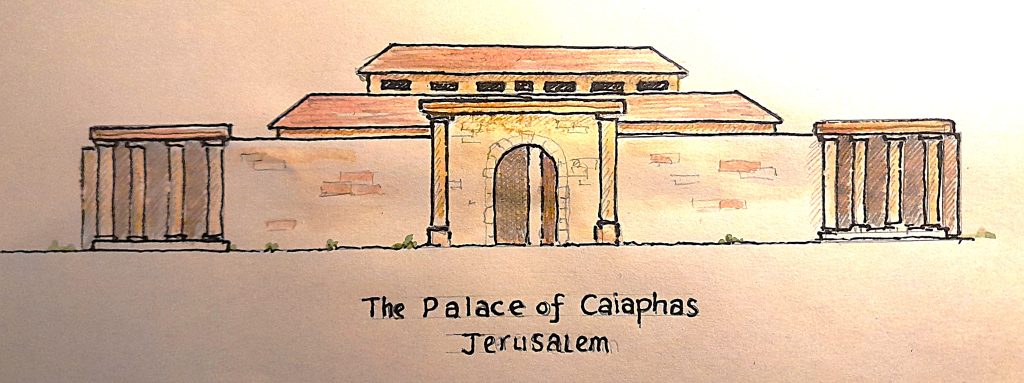
The first denial..
It wasn’t a guard who recognised him. It was a servant girl. She can’t have been in the arrest squad, but she had presumably seen Jesus and his followers in the city earlier. I love Mark’s detail – she looked at him closely before saying ‘This man was with him.‘
‘Woman, I don’t know him.‘ The first denial. Some manuscripts say that the cock crowed for the fist time at this point. Peter didn’t seem to notice. He moves away from the fire and goes to stand by the open entrance gate. The moment passes.
The second denial..
The girl comes back and sees Peter again. She says to anyone who might want to listen, ‘This fellow is one of them.’
‘Man, I am not.‘ (Luke 22:58). The second denial.
It’s too easy to criticize Peter. Out at Gethsemane, the arresting soldiers had tried unsuccessfully to grab some of the followers of Jesus. He had actually drawn his sword and attacked one of the officials. There’s a risk that Peter will be arrested and face interrogation, even death. His very presence anywhere near the Palace of Caiaphas is unbelievable brave. His denials are a human response in the face of life threatening danger.
The third denial..
More time elapses. Luke says it was about an hour. By now, Caiaphas the High Priest has lost his temper and charged Christ with blasphemy. In the room upstairs, Jesus is probably blindfolded and being beaten and abused, when another man sitting or standing close to Peter looks closely at him. Maybe he heard the words of the servant girl earlier. This guy points at Peter. ‘Surely you are one of them. You are a Galilean.’ Peter’s regional accent and clothes have given him away. He looks like a Galilean. He sounds like a Galilean.
Of course there were many Galileans in Jerusalem because it was the Passover. Not all were followers of Jesus. Peter’s response is strong. Scripture says that Peter swore at his accuser. That probably means that he swore in God’s name. ‘I don’t know this man you’re talking about!’
‘It is ironic that Jesus was convicted of blasphemy, but in all probability the one who was committing the blasphemy was down in the courtyard.’ (Sproul, p.353)
Peter remembers what Jesus had said the night before. ‘Before the cock crows you will disown me three times.’ (Mark 14:30))
Peter had sworn that he would never deny Jesus. ‘Even if I have to die with you, I will never disown you!’ (Mark 14:31)
The first lightness of dawn is visible in the sky. Somewhere nearby, a cockerel crows.
In my mind, I think Peter probably moved away from the fire. Perhaps he left the courtyard. He broke down and he wept.
End Piece
The fact that we have the detail of this account is a tribute to the integrity of the man at the centre of the story. It’s good to remind ourselves that Peter was almost certainly the source of the information contained in Mark’s Gospel.
This is a poignant and incredibly moving story which appears in each of the Gospels. I understand why this happens, but it kind of disappoints me that so many preachers and commentators see this as some kind of failure on the part of Peter. There is a sense in which Peter is an easy target. There are some obvious lessons for all of us who follow Jesus about the need for our faithfulness and commitment to Christ. But does that really do justice to the bravery and commitment of Peter?
Before we judge Peter too severely, we need to examine our own lives. How many times have we denied the Lord and lost opportunities to share the gospel with others? Do we, like Peter, talk when we should listen, argue when we should obey, sleep when we should pray, and fight when we should submit? (Weirsbe, p171)
