
‘After scourging him, Pilate gave Jesus over to be crucified..’ Mark 15:15

Horsham: 17th December 2025
The purpose of this post is to look for the context of the phrase ‘After scourging him…‘ It’s a phrase which is hugely meaningful in the context of the story of the events leading up to the crucifixion of Jesus. The horror of this phrase almost hides in plain sight. We pass over it without noticing it. We simply don’t understand the level of violence hidden within that phrase.
I’ve drawn on various sources, listed below, to explain what ‘scourging’ or ‘flogging’ would have involved in Roman Judea in the first century. This post explains what is likely to have happened to Jesus, and many other prisoners who were subsequently crucified in Jerusalem by the Roman occupiers. It is not comfortable reading.

In Mark 15:15 we read that before being handed over to be crucified, Pilate, who found no fault in Jesus, caused Jesus to be flogged . The Greek word used in Mark 15:15 is phragellosas (φραγελλώσας). This word is commonly translated as ‘flogged‘, or more accurately ‘having flogged [him]’. It is also commonly translated as ‘scourged’. For me, this somehow better describes the actual process to which we reasonably believe Christ was subjected.
Scourging is a specific style of flogging. The purpose is to incapacitate and humiliate the prisoner. Scourging was not invented by the Romans, but they perfected their own style of using this violent punishment and torture. It is a despicable punishment.
ROMAN SCOURGING
Throughout Roman history there were many variations of style, so we can’t be sure which type of whip was used on Jesus. However, we can reasonably imagine a leather whip, with a strong, solid handle up to 0.5m long. To will have been joined to a number of strands, usually made of leather, into which have been woven sharp pieces of stone, bone and metal. The Romans called it a flagrum or flagellum.
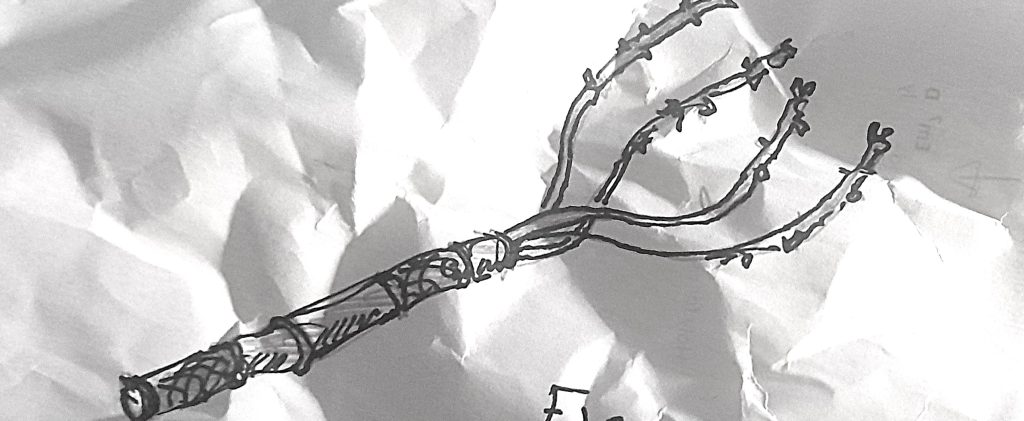
The flagrum was sometimes used as a punishment of slaves and low level offenders, who would carry the scars of their beating for the rest of their lives as a warning to others. The message was simple. ‘Behave. Or this could happen to you.’
There is evidence that the Romans would also use the flagrum to prepare a prisoner for crucifixion, rendering them helpless to resist their fate. After this beating, it was common to make the prisoner carry at least part of their cross to the place of execution. It is almost certainly because of the wounds from this beating that Jesus was unable to carry any part of his own cross (Matthew 27:31-32 Mark 15:21-22).
The process is horrific. The prisoner was stripped naked, before either being tied to a pillar or laid flat on the ground, with his hands and feet extended. To keep control of the prisoner, he would be tied in position. The target area was the back, buttocks, and the back of the legs above the knee. Two guards, each in possession of a flagrum stood, one on each side of the prisoner, taking it in turns to deliver a blow. The strands of the whip strike the body, with the sharpened additions cutting deep into the flesh. Over and over again the prisoner is thrashed by the whips. Roman law placed no limit on the number of times a prisoner could be whipped. The flesh would be torn to shreds, often exposing bone. The force of the impacts could cause catastrophic damage to internal organs. The prisoner, overwhelmed with the pain and suffering shock through loss of blood, will inevitably lose consciousness.
Roman soldiers using the flagrum were masters of their art. Scourging can easily kill the prisoner, and often did. However, when the prisoner was to face crucifixion, a third soldier would monitor the condition of the victim, pausing or stopping the beating before the prisoner succumbed completely.
SCOURGING OF JESUS
In the case of Jesus, the guards have almost certainly been told to keep Jesus alive, although we should not doubt that he was beaten within an inch of his life.
Jesus had been beaten even before he was delivered to Pilate (Mark 14:65). Now he has been scourged by the Romans. His skin will have been shredded. His muscles, and potentially internal organs, will have been severely damaged. He will be suffering from shock. He will be physically shaking. He will scarcely be able to stand without support.
We have already mentioned that for the Romans, this type of flogging was a common precursor to execution. Nonetheless, it has been suggested that in scourging Jesus, Pilate was making one final attempt to encourage the crowd to feel sympathy for Jesus and give him the reason to release him. If that was the case, his attempt failed.
‘After scourging him, Pilate gave Jesus over to be crucified..’
Bible History.com
Three Thirty Ministries
Shroud.com (‘The Hypotheses about the Roman Flagrum’, by F Manservigi (stlmanservigipaper.pdf))
Various additional sources which quote from the writings of Josephus, Philo and Eusabius.